

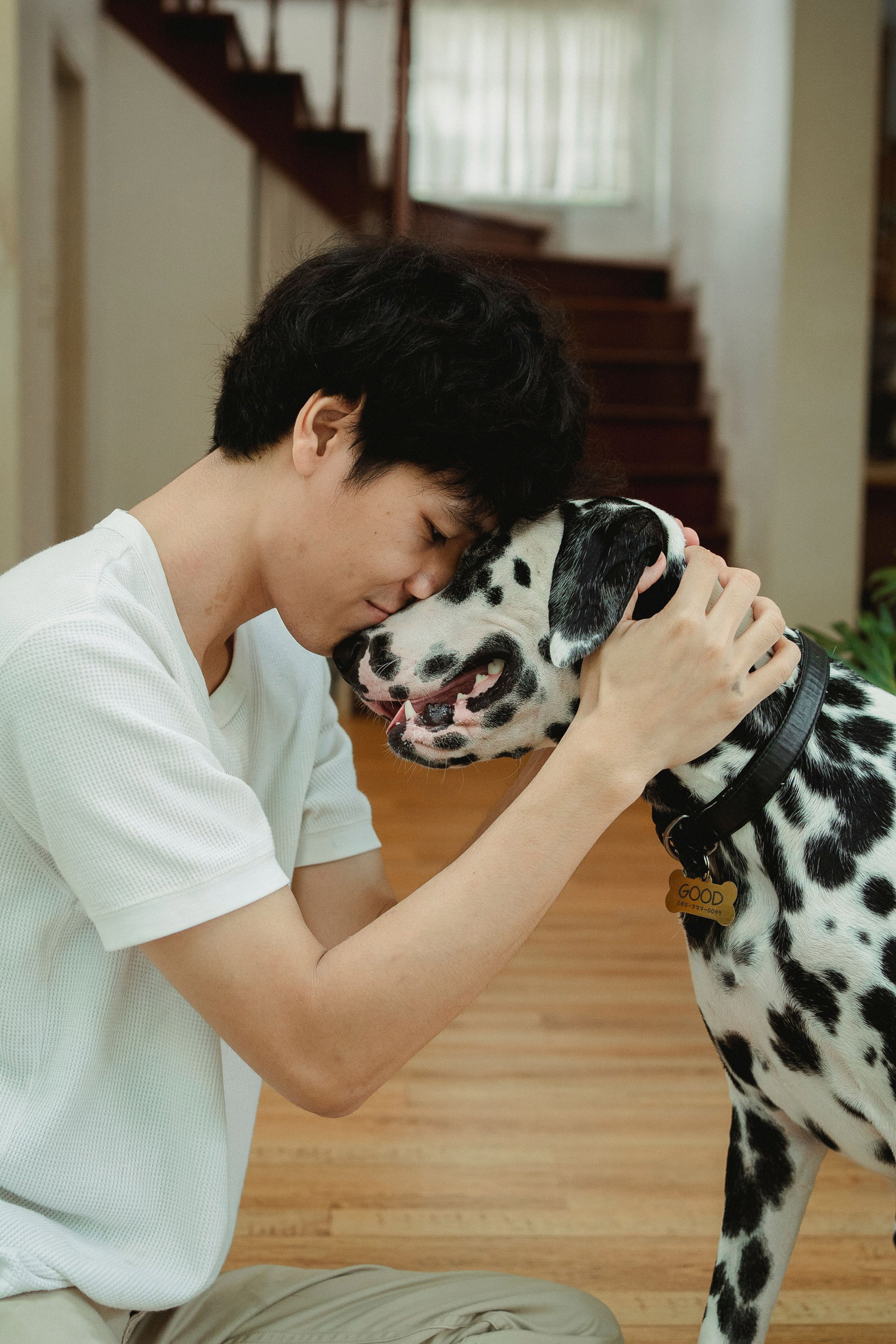
A new study says that dogs can read people’s moods. Tell me something I don’t know, amirite?! Indeed, there are impressive new features to this study. For one, the results are confirmed by MRI scans. (Don’t worry, all participating floofs were awake and unrestrained during testing!) The scans tracked activity across brain regions while dogs were shown images of human faces expressing various emotions. As expected, the dogs registered that positive, negative, and neutral facial images differed from one another. The surprising discovery was that dogs clocked differences within the family of negative emotions. The brain activity recorded on the MRI scans showed that the dogs were distinguishing between fear and anger, and fear and sadness. In short, much more nuanced than the floofs had been given credit for. More on this breaking science news:
Study notes: “As far as we know, it’s the first time there is proof that dogs can distinguish between faces expressing two [similar] emotions,” said Laura V. Cuaya, a co-author of the study and postdoctoral researcher at the SCAN-Unit, University of Vienna. The study, which included two separate experiments, was published in August in the Cell Press journal iScience. It was started at the National Autonomous University of Mexico then expanded to Eötvös Loránd University in Hungary.
Put on a happy face: In the first experiment, eight pet dogs were shown images of happy and neutral human faces that were unfamiliar to them. Happy faces elicited a stronger response in a part of the brain known as the right temporal cluster extending to the caudate nucleus, which is notable because it’s associated with rewards, explained Cuaya. “Other studies show, for example, that this activation is related when the dog is expecting a snack or a food reward, but also when they hear praise,” she said. The team was interested in learning whether the same brain regions would be activated if dogs were exposed to images of negative human emotions as well as happy ones.
Shades of gray emotions: They designed the second experiment with 12 pet dogs, comparing brain regions where happy faces as well as those exhibiting sadness, anger and fear were processed. Their results sugggested “there is a distinction between happiness and the negative emotions,” said Raúl Hernández-Pérez, a postdoctoral researcher at the SCAN Unit, University of Vienna, and author of the study. The researchers ran a whole-brain analysis to look at patterns of response between those three negative emotions. “We found that in a different part of the brain, there can be a distinction between fear and anger and between fear and sadness” said Cuaya. She added that there did not seem to be a difference in processing between sadness and anger.
Next steps: “If you can imagine the world from the dog’s perspective, the body is more important,” said Cuaya. With this in mind, she and Hernández-Pérez are now running an experiment in which the dogs watch videos of people acting out various emotions with faces digitally obscured. Dog cognition is a relatively new field, and very few labs in the world do these kinds of studies. The hope, said experts, is that future research can address bigger questions not only about how dogs perceive us but the nature of animal minds in general. While we can peer into a dog’s brain using an MRI, for example, we don’t know whether they’re thinking about our emotions with real meaning.
Of course dogs can track subtle differences in human emotions, otherwise we wouldn’t have so many canine movie stars breaking out in Hollywood recently! For Fido’s sake, didn’t these researchers see Messi the border collie (remember that breed for later) steal scenes in Anatomy of a Fall three years ago? And just this year Indy the dog beat out five human actors (two of them Oscar nominees!) to win Best Performance in a Horror/Thriller at the Astra Awards — and it was his first film! My point is, you can’t be capable of turning in an emotionally devastating performance unless you have a visceral understanding of the rich emotions involved in the first place. Though I suppose now is a good time to underscore that the researchers stress the results merely confirm dogs recognize differences/distinctions between emotions; the results of this study don’t speak to how dogs understand or interpret the varying human emotions. (Next study?) Another factor to note is that most of the test subjects were border collies, because their breeding makes them particularly adept at working with humans. An obvious next avenue of research would be to open up the testing to more breeds.
And finally, to all bitches out there contemplating career paths: take this as a reminder that the life of a scientist can include work like making faces at dogs to see how they react, playing disco music to time sea lions bopping their heads to the beat, or observing how cats can turn the loving action of grooming into a passive aggressive show of displeasure. Science for the win!
Photos credit: Nano Erdozain, Thirdman, Bethany Ferr on Pexels










I live with three dogs who have made me and my reactions their chief study in life. Of course dogs understand, and act accordingly. Anyone who has been upset, and has had a dog come over to them and gently console, knows how this works, but it’s nice to have it confirmed by a study.
Cats can too. They just DGAF most of the time.
Signed,
lifelong cat lady (with a kid! but I have more cats than I do kids)
The cat I grew up with knew my moods so well. I struggled with depression as a teen and my beautiful fluff always knew when I needed him to snuggle with me.
Same with my Spike, my old former street cat rescue. But my friend has a cat, Smokey, that likes to be seen as a above such nonsense lol
They should meet my miracle pup who starts barking for breakfast at 6am with ZERO sense of my mood.
🤭
We always joke that our dog would be a terrible therapy dog because at the first sign of tears — or even a suspicious sniffle — she pounces on us and tries to lick the tears away.
After my Mom died, I had to cry in the shower or in my car so I wouldn’t upset my dog.
And she always knows when someone isn’t feeling well because she tucks herself against that person. I love my dog so much.
My beagle, whom we, his family, consider Satan’s cutest spawn on this earth, knew I was pregnant even before I had an inkling. I was suddenly the only one he’d listen to and he was stuck to me like glue, never leaving my side. I was never his Alpha, hubby was – except for those nine months of pregnancy.
He was half as attentive to my son as a toddler, especially if he picked him by the leash.
Today, if I collapsed by his side in a flood of tears, he’d probably – probably! – open an eye to look at me, though likely not. Dogs have extra senses, but I think it varies depending on breeds, so yeah, more studies in this direction would be nice.
My dog can sense my feelings from across the room. When i had major surgery, she was the best caretaker when I returned home. I had reoccurring nightmares afterwards, and she’d nuzzle my arm and wake me up when it got too bad.
The best thing about knowing they can sense our emotions, is the hope that she understands how much I love her.
My dogs and cats take note of my mood. My cats aren’t as concerned typically, unless I’m sick then they are all puzzled,
‘Don’t worry, all participating floofs were awake and unrestrained during testing!’ How? I’ve had brain MRIs and they are not fun, they clamp down your head in this white plastic mask like Hannibal Lecter’s. It’s totally horrible PLUS the noise? Poor doggies.
I have a Border Collie. And let me tell you, this dog is smart. I suffer from PTSD, Anxiety and Depression. He was a rescue, paid $100 donation fee to the rescue. He is the best damn dog. He knows when I have an attack coming on and literally hugs me. He doesn’t leave until I tell him it’s okay. I wasn’t a dog person before my first rescue. Now I can not imagine my life without a dog in it.