

When I was a kid in school we didn’t have computers in the classrooms, but instead a “computer lab” shared by all grades, primarily for learning how to touch type and then simple word processing. Furthermore, students did not use laptops or tablets in school; we handwrote lesson notes on paper. I have no doubt I would feel like a Flintstone walking into the Jetson classrooms of today. From equipment to its dominant search engine, Google has embedded itself in the business of learning. Now more than ever, that is a fraught prospect given the AI of it all. Schools would like the ability to set parameters on students’ access to AI on Google products, while a growing number of parents would like to see AI banned from schools altogether. So this week, Google magnanimously announced that starting in 2027 it will turn off AI in its classroom software, but still leave the option for schools to decide to make AI available. Here’s the rub: Google is stacking the decks so that schools choosing to restrict AI will lose access to Google search altogether. Those little weasels.
A.I. features are now a standard part of Google’s commercially available search engine. “Search and A.I. are deeply integrated,” said Chris Phillips, vice president for education at Google. If a school has banned A.I., he added, students “will not have access to search, and they’ll see a message from their school that indicates it’s not available.”
Google is by far the dominant technology player in K-12 classrooms. Google’s suite of education apps — including Gmail, Docs and an assignment platform called Classroom — is ubiquitous. Google Chromebooks, low-cost laptops, are the most widely issued student devices in U.S. schools. And Google is synonymous with internet search, a crucial tool for students across the globe.
…Lina Khan, a former chair of the Federal Trade Commission, said in a statement that Google was using its “search monopoly to coerce schools” into adopting its A.I. She added that multiple courts had found the tech giant liable for violating antitrust laws.
“This latest move shows it remains unchastened,” Ms. Khan said of Google’s new A.I. changes for schools. “As the public increasingly pushes back against the use of AI in schools,” she added, “Google is making clear it will punish those who don’t fall in line.”
In recent months, Google has been promoting its Gemini chatbot as a valuable educational tool, saying it can aid teachers in planning lessons and serve as a personalized tutor for students. A new student feature within Gemini, Guided Learning, is supposed to make it harder for students to use A.I. to cheat.
“We’re evolving our approach,” said Mr. Phillips. He promised tools that would “support the productive struggle” of learning and tamp down on students turning to A.I. for easy answers.
…On Monday, Google executives said that for districts that do allow A.I., there will be two options for search inside school-issued accounts, beginning in early 2027. One option will be search with A.I. overviews and A.I. chats turned on, similar to the current consumer experience. The other will be search using Guided Learning, the student feature within Google’s Gemini chatbot.
Guided Learning is intended to guide students through a topic step-by-step without providing them with answers that could short-circuit learning. It is supposed to offer an experience modeled on one-to-one tutoring.
The consumer version of Guided Learning is already available within Gemini, and can enable cheating. In a reporter’s test, it produced a detailed essay in response to an Advanced Placement history prompt.
Giving credit where it’s due, CB had salient takes on what she coined the “Google mafia.” For one, like the Google employee himself said, “Search and A.I. are deeply integrated,” to the point where CB wonders if Google is even capable anymore of running search without AI involved. The other idea, which I think is the real big issue for Google, is that if they can provide Google search and allow schools to turn off the AI overview, then the rest of us are going to demand that option as well. Lord knows I tried to shut down the AI responses before realizing Google wouldn’t let me. But the big losers here are students who are being deprived of the “productive struggle” of having to make an effort to understand something/obtain knowledge. (And who also, if they only go by Google, are left to think there’s a Gulf of/Lake America.) How does Google have the gall to say their programs deter kids from seeking “easy answers,” when that’s the whole pitch they’re making to adults to use AI? We’re doing such a disservice to these younger generations, with the potential for serious consequences once the world is in their hands.
Among the many, many encouraging parts of Tuesday night’s big Blue Tsunami, is the idea that voters clapped back on tech billionaires telling us that AI is inevitable. It isn’t, we know it isn’t, and we’re organizing to rewrite their narrative.
Note by CB: Here’s how to switch to Duck Duck Go as your default search engine.













Bring back encyclopedias and microfiche into schools!
I’m so disappointed with Google. Used to love them. Have switched over to DuckDuckGo no ai for all my searches at work, home, and on my phone. I use their browser on my phone, and I switched to either Firefox or Brave on my home computer.
Their motto used to be
Don’t Be Evil
They changed it years ago and it shows.
Though as a wise friend used to say, “Don’t believe their Don’t Be Evil claims, they chose to model their corporate icon after the Death Star”
European users luckily have choices.
I use the Firefox browser with Startpage search. Which gives Google-like results without tracking, privacy concerns or generative, unwanted AI.
Fingers crossed that the Bluenami and the push-back against data centers and AI causes Google a significant loss of market shares.
Europeans have way more rights than people from the US when it comes to data privacy.
I’ve been using Duck Duck Go for a few years and love it. This morning I tried to use google for a search and all the returns were sponsored links. Utterly useless. I can’t see the value of using Google at all anymore for anything.
OK, the consensus seems to be that DuckDuckGo is the replacement search engine of choice, but what about email servers? Any recommendations? I’ve always really liked Gmail, but now it’s tainted. I feel like those people who put “I bought this before I knew Elon was a Nazi” stickers on their Teslas.
I’m sorry—WHAT?!?
Here’s to the beginning of getting Big Tech out of our schools.
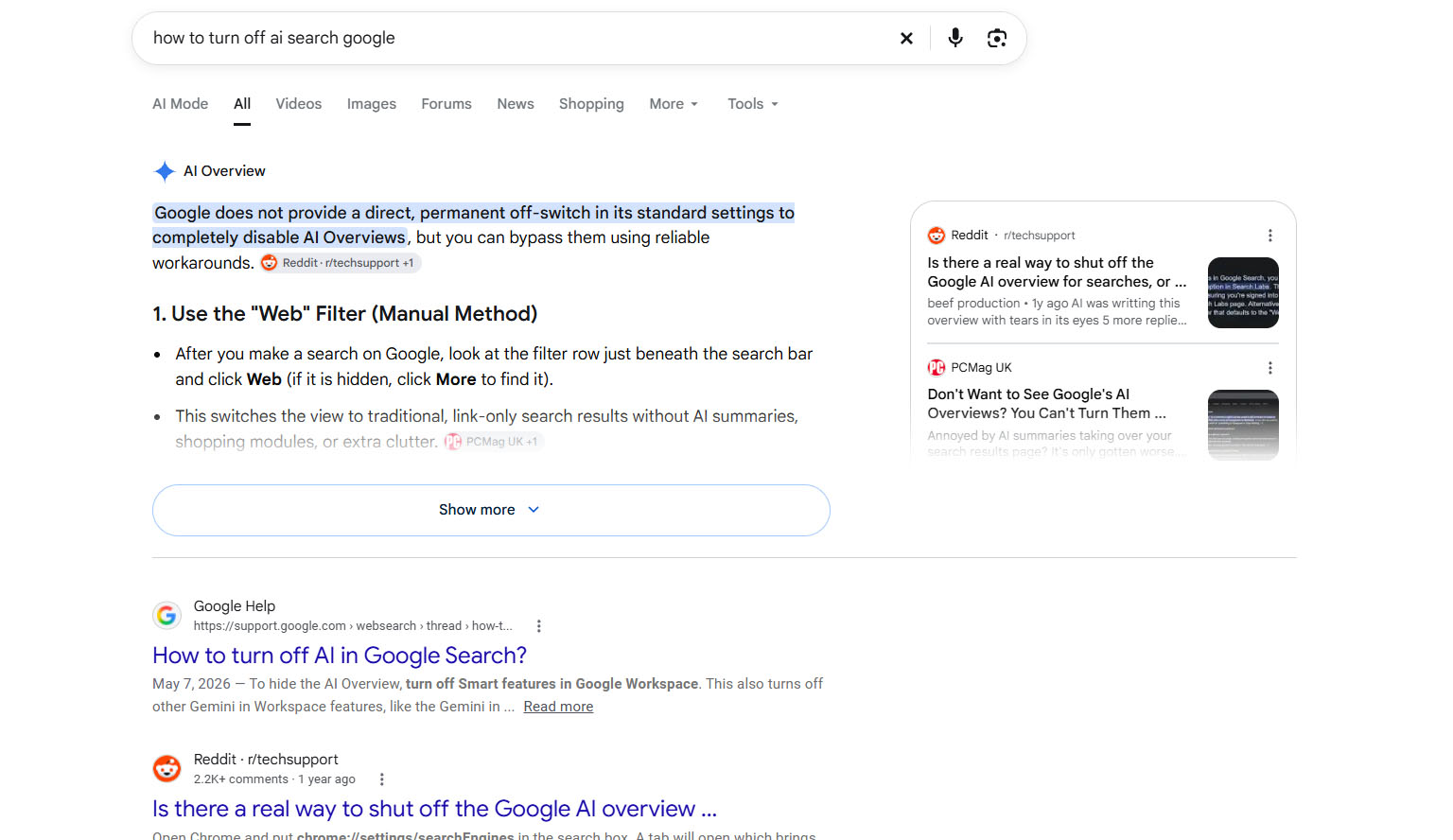
Google will generally leave AI out of its search, if you type “-ai” at the end of your search term.
Elder millennial here. Even after we got the internet in the mid-90s, when I was starting high school, we still weren’t really allowed to use it for research. We had to use books. Books are great.
They are basically begging to have their asses hauled in front of a congressional committee. Part of this is local governments being too stingy to actually fund their schools, accepting free stuff from Google at the cost of having our kids become the product, feeding their data into Googles’s maw
Thé edtech industry is terrible. Stupid and predatory