
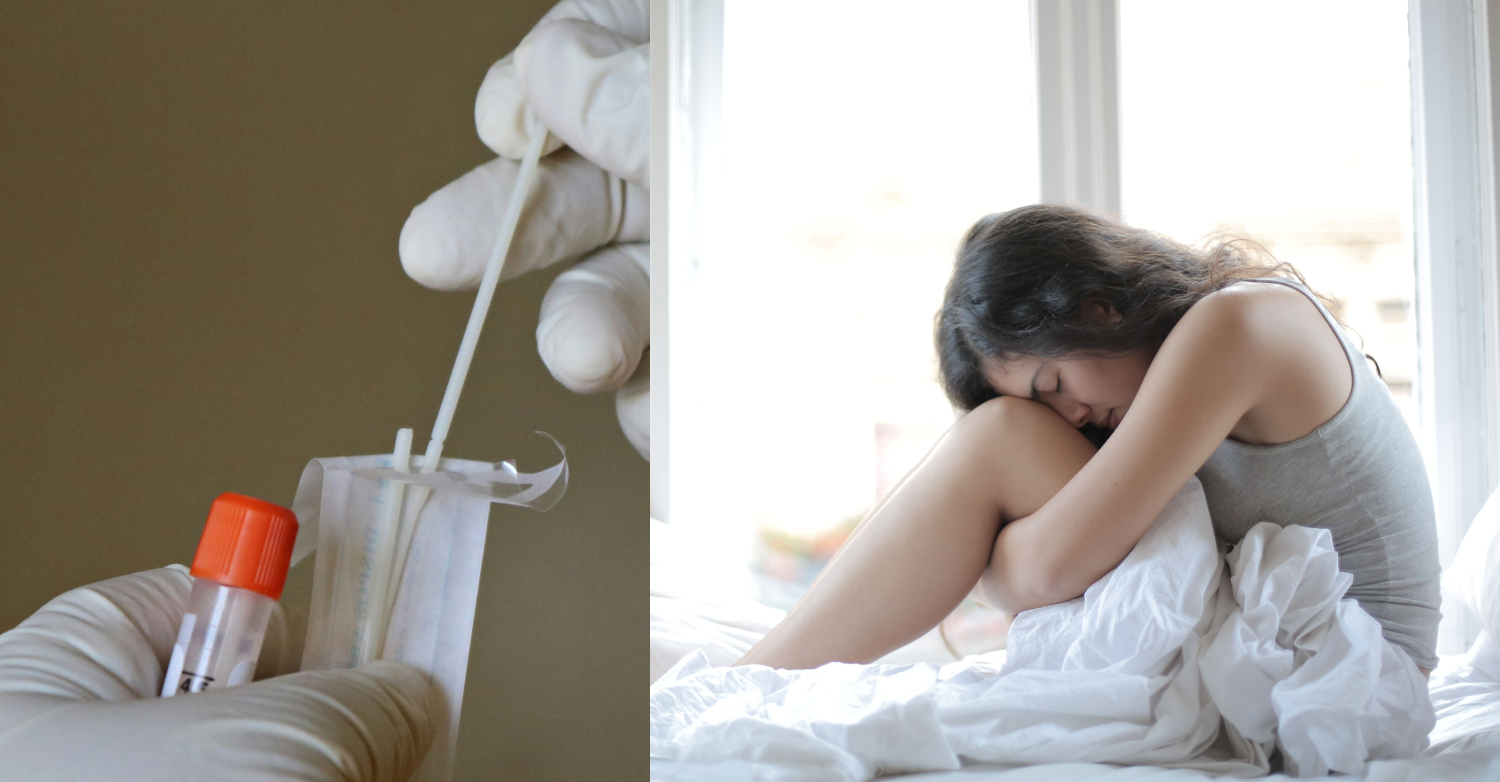
Endometriosis is notoriously difficult to diagnose because its symptoms are often mistaken for other medical conditions. Some women suffer for over a decade before doctors are able to properly diagnose it, and a definitive diagnosis usually requires laparoscopic surgery. It’s a long, frustrating process. Well, there’s finally some good news on this front.
Two new non-invasive tests that could make it significantly easier to diagnose endometriosis were just recommended for use by the UK’s National Health Service. (They are currently only available in private UK healthcare.) The first test, EndoSure, measures electrical signals in the gut to detect endometriosis. The second one, Endotest, is a rapid saliva test. Endotest detects biological markers called microRNAs that indicate whether endometriosis is present. Here’s more from People:
Women may no longer have to wait several years to get an endometriosis diagnosis.
On Tuesday, July 7, the National Institute for Health and Care Excellence (NICE) announced a new draft guidance for the National Health Service (NHS) in England and Wales. The agency has greenlit two tests, EndoSure and Endotest, to meaningfully reduce the time it takes for women to be diagnosed with endometriosis.
Endometriosis is the reproductive condition in which uterine tissue grows outside of the uterus, causing cramping and chronic pain. It affects about 1 in 10 women worldwide. However, on average there is a four- to 11-year delay between the onset of symptoms and diagnosis, according to Yale Medicine.
With Endotest, women provide a saliva sample that’s checked in a lab for tiny biological markers called microRNAs, which can indicate whether endometriosis is likely present.
EndoSure detects endometriosis by measuring electrical signals in the gut using sensor pads on the abdomen. Women are required to fast for six to eight hours beforehand and drink water during the 45-minute test.
These new technologies offer a less invasive and faster approach to receiving a diagnosis, compared to the typical laparoscopic surgery.
NICE points out that neither is designed to be standalone diagnostic tests, and they should be used alongside standard clinical practice. The agency said that not every general practitioner will have immediate access to EndoSure and Endotest, and use will be funded and overseen by the NHS.
The two tests have been approved for a three-year period while additional evidence is collected on how well they work.
“A diagnosis of endometriosis can for some women take the best part of a decade, with the UK average standing at 9 years and 4 months, and rising to 11 years for those from ethnically diverse communities. That delay means living with chronic pelvic pain that affects daily life, relationships and work,” Dr. Anastasia Chalkidou, healthtech program director at NICE, said in a statement. “These technologies have the potential to change that by giving primary care professionals better non-invasive tools to identify endometriosis earlier allowing earlier and better treatment.”
Dr. Gail Busby, consultant gynaecologist at Manchester University NHS Foundation Trust, added, “Too many of my patients have spent years being told their pain is normal when it isn’t. These tests are a game-changer because they give us answers much earlier, without the need for invasive surgery, and that means we can start the right treatment sooner. An earlier diagnosis doesn’t just change one person’s life, it frees up appointments and surgical slots for everyone waiting for care.”
This is great news. Women are expected to endure a lot when it comes to reproductive health. To go from surgery to a simple saliva test is a remarkable medical advance. Studies have found that both tests have accuracy rates between 96% and 99%. As Dr. Busby points out, faster diagnoses don’t just help one patient. They also free up appointments that allow other women to get medical attention. If these tests prove successful, they could improve the quality of life for millions of people worldwide.
Right now, EndoSure is only available in the UK and Canada, while Endotest is administered in several countries throughout Europe, the Middle East, Asia, and South America, as well as Canada. Neither test is available in the US yet. I hope that changes soon. I’m sure our healthcare system will find some way to screw it up, but I really hope insurance providers cover them whenever they become available here.

Photos credit: Photos by Mufid Majnun and Poonam on Unsplash, Andrea Piacquadio on Pexels











Imagine what can be done for women’s health if we only pay attention!
Thank you for this Rosie. I’ve just sent this article to my sister, because I’ve suspected for years that she is suffering from endometriosis, but so far the doctors have looked at every possibility BUT that. Navigating the NHS system, beneficial as it is, can be complicated at times. Fortunately, she has private health insurance, but she often has to do her own research then tell the private doctors what she wants investigated.
I hope your sister gets some answers soon!
FINALLY a female medical 😱 being treated like so many male medical disorders…Thank you for this…💔🇺🇸💔 will have to rely on the rest of the 🌏 when it comes to medical research now…just like in the 80s when Reagan was POTUS & no Federal funding 💲 was being allocated to identifying the HIV virus. .
I’m tired 😫
This is fantastic news!!! Hopefully the US will fast-track this much less invasive diagnostic tool so women can get treated much faster.
It took YEARS before I found a doctor who took me and my symptoms seriously. After my Army father demanded that the doctors do something (I had excruciating cramps, couldn’t keep any food down and they were constantly taking me to the ER), my father had to give his written authorization for the Army docs to put 15 year old me on birth control pills. These helped until my early 20s. Every male GYN I had, until my mid 20s, condescending told me that “Pregnancy will cure that”, to which I responded” Is that a guarantee, and if it doesn’t, you’ll raise that child?”. And then had the audacity to look at me like I was the crazy one…The pills worked until my mid20s, when I started missing a lot of work. When I was 25, a co-worker recommended her GYN to me, who took me seriously, told me that (at that time) the only way to diagnose and treat endometriosis was thru laparoscopic surgery. Which I underwent and it showed that I had widespread endometriosis, and was the first time I got that diagnosis. He removed all of it except that which had spread to my bladder. He explained that it too would spread but I should be painfree for a while, and I was, until my mid 30s. I tried every new treatment he recommended with varying success, until he decided to keep me on continuous birth control (not take the placebo pills but start a new pack on week 4 instead). Which worked wonderfully for about a decade. And then I hit premenopause 😱
Several doctors gave me this excellent advice for those with medical conditions:
1. Never let a doctor ignore or minimize your pain/symptoms (If they do, find another one)
2. Don’t let anyone silence you – You are your own best advocate when it comes to medical care bc they only see you occasionally, whereas you’re dealing with your health issues daily.
3. Don’t be afraid to ask questions. Most doctors don’t mind explaining medical terminology/jargon, medications/side effects, and treatment regimens. Some of my docs like to talk to me like I went to medical school and I only understand 20% of what they’re saying. Plus I do my own research bc I have a complicated medical history.
This is wonderful news! I hope it starts being used in the US soon though, when I spent nearly 40 years trying to figure out what wrong with me and thought it was endometriosis, my biggest hurdle was doctors who dismissed my symptoms and refused to test me for it. (It turned out I had adenomyosis not endo, I’d never heard of adenomyosis until the diagnosis. I hope that it becomes more widely known and testing for it improves as well.)
I never knew I had endometriosis.Next Monday, I’m having a hysterectomy after two years of pain and severe bleeding. They finally found an ovarian endometrioma—a “chocolate cyst” caused by endometriosis.Looking back, the signs were all so obvious. But so many of us are taught to push through the pain, to endure, and to keep going.
I hope we keep getting these medical advances sooner rather than later. Thanks Rosie for bringing this forward. We need to normalize women’s reproductive health.
Endometriosis is honestly the weirdest disease. I don’t have one day in the month when I don’t have some weird problem associated with it. The only positive aspect is that now I don’t freak out when I’m feeling some pain from anywhere because you can bet that it is going to be because of endo.
Brain fog might be the most tedious and annoying symptom because there is literally nothing to do other than wait for it to go away. I just end up feeling as if I’m floating out of my body throughout the day, it’s wild.
I got diagnosed at like 30 but I first went to an MRI where the specialist said that I didn’t have endo and sent me back home telling me to eat better. I went to another specialist who did an ultrasound and it turned out that I did have A LOT of endometriosis lesions.