
One of the funniest stories last week was Classics professor and translator Emily Wilson’s scathing critique of Christopher Nolan’s The Odyssey. Nolan had actually cited Wilson and her Odyssey translation as important inspirations for his adapted script. Make no mistake, Wilson’s critique was mostly about the script and how Nolan adapted the story to suit his own agenda, although it’s clear that Wilson didn’t really care for the direction either. As I wrote when Joyce Carol Oates chimed in on Wilson’s critique, I love the whole controversy, and I love that Wilson is using Nolan’s film to have a larger conversation about what The Odyssey (the real text) is actually about. Well, Wilson is still critiquing. She’s written a new piece for the Atlantic about how Nolan’s script hinges around “Zeus’s law” and how the Trojan horse was the ultimate betrayal of Zeus’s law. Wilson pointed out the obvious contradiction:
Emily Wilson, the author whose 2017 translation of “The Odyssey” was an influence for Christopher Nolan during his own adaptation process, is doubling down in her critiques of the director’s blockbuster epic. In an op-ed written for The Atlantic, Wilson called out Nolan’s “Odyssey” for being “emotionally empty.” She previously torched the movie in a review published by the London Review of Books in which she called Nolan’s screenplay “abysmal” and added: “I would be ashamed to have written any part of this script.”
In her op-ed for the Atlantic, Wilson explains how one of her big issues with Nolan’s movie is its approach to “Zeus’ law.” The phrase is repeated numerous times by characters in the movie and is a variation of the Golden Rule: “We must host beggars and strangers kindly, to ‘do as we would be done by,’ and because they could be gods in disguise.” Nolan’s movie reckons with how Odysseus (Matt Damon) breaks Zeus’ law by coming up with the plan for the Trojan Horse and executing it in an attempt to sack the city of Troy through a deception. But Wilson is not sold on Nolan’s interpretation here.
As Wilson explains: “The horse is presented as the ultimate violation of the law of Zeus, because it entails wielding a weapon of mass destruction disguised as a gift… The horse is presented as breaking ‘civilization’ because it represents the moment when the good guy, Odysseus, echoes the behavior of the bad guy by being a deceitful, ungrateful guest. But the film does not explain what ‘hospitality’ has to do with a narrative situation in which the Greeks have been besieging Troy for 10 years already [which Nolan’s movie does not depict]; the Trojans are not their hosts but their enemies in war. If the war is bad, it is nonsensical to suggest that the most important turning point is the use of the horse rather than Agamemnon’s choice to invade Troy in the first place and Odysseus’s choice to yield to the empire’s demands. The visually impressive spectacle of the horse on a stunning stretch of pristine beach contributes to the narrative muddle: The Greeks have supposedly been encamped there for the past decade, yet it shows no sign of human habitation.”
According to Wilson, Nolan’s “Odyssey” is “not interested in the social or psychological questions of how people deceive and are deceived.” She takes issue with the dissonance between the director’s script and his direction. The screenplay “grandly insists on the importance of human kindness, while the camera shows us an entirely different set of values,” she argues, explaining that Nolan’s direction is mostly concerned with the “mechanical challenge of moving objects through space,” be it the Trojan Horse or ships or more.
“What matters cinematically are the logistics: the rolling of the horse uphill and the claustrophobic, waterlogged interior. Once the ambush of the Trojans begins, the camera lingers repeatedly not on the human actors but on the enflamed, toppling buildings and the great gates of the city, whose slow-moving mechanism is observed at great length,” Wilson writes. “The script tells us loudly that people matter, but the camera shows us that what matters is the mechanical challenge of moving objects through space.”
“Nolan’s Odyssey is itself a kind of Trojan horse,” she continued. “The script grandly insists on the importance of human kindness, while the camera shows us an entirely different set of values. In these times of hatred and misinformation, we need more than the ‘apparent magic’ of deceptive images. We need art that is truthful about the costs and the necessity of compassion, and that recognizes that a sense of spiritual superiority may not protect us from lies. These lessons are legible in Homer and Virgil, but are elided by Nolan’s visually stunning, emotionally empty film.”
Yeah, I’m sorry but Wilson really got his ass. Nolan is absolutely obsessed with “moving objects through space,” and not so obsessed with morally ambiguous men and women making decisions for complicated reasons. This is important too: “If the war is bad, it is nonsensical to suggest that the most important turning point is the use of the horse rather than Agamemnon’s choice to invade Troy in the first place and Odysseus’s choice to yield to the empire’s demands.” Exactly!! While The Odyssey is not specifically about the ten-year Trojan War, Wilson’s argument is that the movie treats the horse like it was the thing which broke “Zeus’s law” – Wilson is saying that the war itself was the original sin. Although one could absolutely argue that the real original sin was Paris “abducting” Helen (which was surely the ultimate violation of Zeus’s law??). Anyway, I’m totally fine with Professor Wilson continuing to use this film as an excuse to educate people on what the actual Greek myths are actually about.
Photos courtesy of Avalon Red, Cover Images. Poster courtesy of ‘The Odyssey’.
-

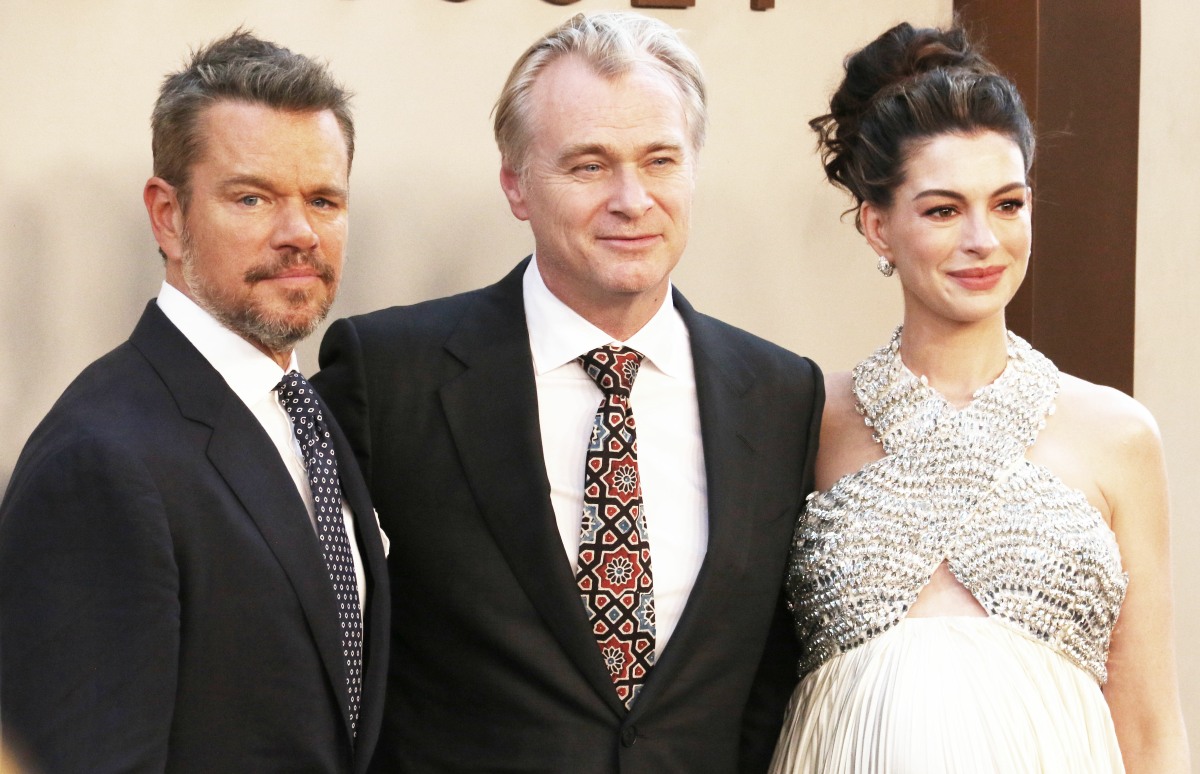
- Premiere of ‘The Odyssey’ at AMC Lincoln Square Featuring: Matt Damon, Christopher Nolan, Anne Hathaway Where: New York City, New York, United States When: 14 Jul 2026 Credit: Roger Wong/INSTARimages
-

- Christopher Nolan attends the world premiere of “The Odyssey” at Odeon Luxe Leicester Square on July 06, 2026 in London, England.,Image: 1114880185, License: Rights-managed, Restrictions: , Model Release: no , Credit line: Lounis Tiar/Avalon
-

- Matt Damon and Luciana Barroso attend the world premiere of “The Odyssey” at Odeon Luxe Leicester Square on July 06, 2026 in London, England.,Image: 1114881626, License: Rights-managed, Restrictions: , Model Release: no , Credit line: Lounis Tiar/Avalon
-

- Christopher Nolan and Emma Thomas attending The Odyssey World Premiere at the Odeon Luxe in Leicester Square, London, United Kingdom,Image: 1115006704, License: Rights-managed, Restrictions: , Model Release: no , Credit line: Cat Morley/Avalon
-

- Photocall for ‘The Odyssey’ at the IET Building Featuring: Tom Holland, Anne Hathaway, Matt Damon and Robert Pattinson Where: London, United Kingdom When: 05 Jul 2026 Credit: Jordan PettittPA Images/INSTARimages **NORTH AMERICA RIGHTS ONLY**
-

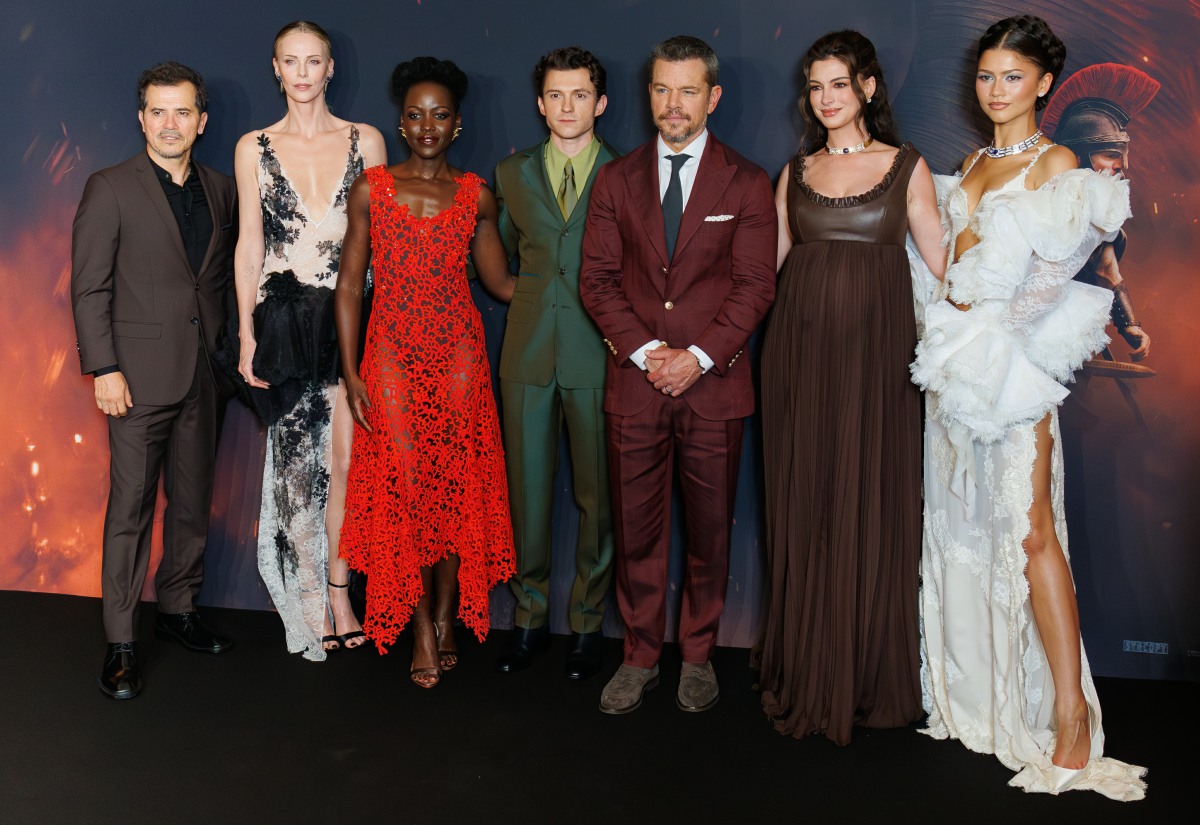
- Paris premiere of ‘The Odyssey’ at the Grand Rex theater Featuring: John Leguizamo, Charlize Theron, Lupita Nyong’o, Tom Holland, Matt Damon, Anne Hathaway, Zendaya, Emma Thomas and Christopher Nolan Where: Paris, France When: 08 Jul 2026 Credit: Sebastien Fremont/Starface Photo/Cover Images **UK AND USA RIGHTS ONLY**
-

- Paris premiere of ‘The Odyssey’ at the Grand Rex theater Featuring: John Leguizamo, Charlize Theron, Lupita Nyong’o, Tom Holland, Matt Damon, Anne Hathaway and Zendaya Where: Paris, France When: 08 Jul 2026 Credit: Sebastien Fremont/Starface Photo/Cover Images **UK AND USA RIGHTS ONLY**
-
- NY Premiere of ‘The Odyssey’ Featuring: Matt Damon, Christopher Nolan, Anne Hathaway Where: New York, New York, United States When: 15 Jul 2026 Credit: Janet Mayer/INSTARimages.com










I highly recommend Wilson’s intro to the Odyssey (approximately 100 pages in the hardcover version) because it is an outstanding example of scholarship written to inform a general audience about The Odyssey as a text and its reception during the Bronze Age and Classical eras, as well as updated conclusions drawn from newer archaeological discoveries.
She is a serious scholar whose complaints reside in Nolan’s interpretation of the text and not an “elitist” taking aim at Hollywood. If Nolan deserves to be taken as a serious filmmaker then Wilson also deserves to be taken just as seriously as a scholar and translator. I really dislike the media framing as “well it is just great that this debate over an ancient text is still creating discussion” because that’s the most obvious and benign conclusion anyone could possibly find re: a literary adaptation.
I think a broader, more interesting question raised by Wilson and Nolan might ask if The Odyssey as a (Christianized) morality tale is more palatable to Western audiences or if a more wild interpretation (the substance of Wilson’s critiques) can ever be received as authentic or successful – even if the “wild” interpretation is closer to the actual reception or culture of The Odyssey’s original audience. Moreover, art is always a form of representation so taking any one translation or film as “truthful” also misses the whole point of artistic endeavors? So it seems more interesting to think and debate about what The Odyssey has to compel and interest modern and contemporary audiences without Hollywood stars, Christianized framing (the breaking of hospitality is cited by Dante, iirc) or the respect commanded by someone of Nolan’s stature.
If it seems like I was trying to contradict you in my comment below, I wasn’t. All of your points are valid. Nolan DOES want to be taken seriously and he cited her translation as an inspiration. So she deserves to be heard on this. I never saw her critique as a snobby elitist takedown of Hollywood. I actually want to see the movie in part so I can determine if I agree with her or not. I’m curious.
It’s definitely worth seeing, I enjoyed the experience and was really jazzed to see so many ages/groups/people excited to watch a movie about an ancient poem! One aspect of Nolan’s The Odyssey that hasn’t been really remarked upon are some wonderful visual homages to Pasolini’s movies about Greek myths, particularly in the shots of landscapes framing the actors. I don’t know if those are Nolan’s influence or his cinematographer’s, and not sure if that matters in the end, but it’s always really interesting (to me) to find the ways an artist can pay respect to the work that came before him(/her/them).
@Frida Xolo thank you for the additional recommendations and references… I love and 100% agree with what you shared here, and especially: “Moreover, art is always a form of representation so taking any one translation or film as “truthful” also misses the whole point of artistic endeavors?”
And am wondering about this – when we are decades in on “the medium is the message” for mainstream cinema – this feels like a thought experiment, what art form did you have in mind here – still cinema, but indie? I’m curious to learn more. “So it seems more interesting to think and debate about what The Odyssey has to compel and interest modern and contemporary audiences without Hollywood stars, Christianized framing (the breaking of hospitality is cited by Dante, iirc) or the respect commanded by someone of Nolan’s stature.”
Thank you for such a thoughtful comment, and to answer your question, I’m going about it in a roundabout way so apologies if this is hard to follow.
First, what I think has not been mentioned is that translations are not the same as artistic representation. Both are forms of interpretations BUT more importantly, translation vs representation is a difference (with distinction) that separates Wilson’s understanding of The Odyssey and Nolan’s cinematic representation. I don’t think this basic point has been noted quite enough? The two come from fundamentally different approaches to, and uses of, the “original” text.
Pasolini’s Oedipus Rex is a really good example of a director who “stuck to the text” for his dialogue, and aimed to present the story of Oedipus Rex as authentically as possible (given the production and technology available at the time). His actors have the stillness and monumentality somewhat expected of a “classical” aesthetic, and the gorgeous landscape shots reinforce the sense of gods vs man. It may not be a movie to everyone’s tastes (my husband was NOT thrilled by my choice for movie night, lmao) but, along with Nolan’s movie, serves as really good case studies as to serious filmmakers’ approaches to a similar endeavor.
Finally, I think a “wild” approach to The Odyssey might try to show the way those stories were so important to Bronze Age audiences, to the extent that there were “accepted” versions of the stories and characterizations of The Odyssey, and how these series of tales became essential to forming Greek identity. I would love to see imagined scenes of bards telling the stories to various audiences, those audiences taking those stories back with them to tell their friends/families, and how they incorporate the received (or perceived) lessons of The Odyssey. It might be a bit postmodern to show the creation of a myth but maybe today’s audiences could identify with that kind of cultural reception of the story (vs the story itself).
I got more thoughts but I have to run to a meeting, and really enjoyed thinking about your comment!
@Frida’s Xolo well now you have me all excited for these possibilities, thank you for sharing your imaginations. And – one really truly lovely thing in the midst of the hellscape of 2026 – is that the door is open to something like this: there is an audience now for different explorations of Odyssey by Homer.
New creators will have to get around inevitable comparisons to Christopher Nolan’s The Odyssey, but they can be smart about that – including leveraging it for interest – steer into the Scylla to avoid Charybdis (?! as it were). Thanks for the enriching and enlightening convo this morning. Let’s keep talking about The Odyssey – thank you CB!
Absolutely. It would also be interesting to consider what an adaptation made by a woman would look like.
I haven’t seen the movie yet. It’s been a huge success and I’m sure it’s a very fine example of film making. But I’m enjoying the debate it’s sparked. Let’s have the conversation! All of this has made me more interested in seeing it, not less.
My God. Who cares. I honestly think she’s ticked off other classicists disagreed with her and all pointed out that it was saying inspired by the Odyssey. He didn’t have to do the entire story from end to tail. It was already 3 hours long. I loved it and I have read the original Homer and I really don’t want to keep reading about her.
I’m with you! Isn’t the point of art that you can have different interpretations of things?
There is a difference between different interpretations (like what we see with Jane Austen movies) and incorrect character personalities – as well as changing the ending.
Agreed. And @seraphina she sounds like Elon Musk now. The best review I have read about this movie is from Jeff Yang who looked at it in the lens of Nolan criticizing America and when you see it that way it makes sense. But heck, even Troy changed the ending of what happened and I didn’t see anyone losing their mind about that. Xena Warrior Princess did too.
@chilllinginDC, who sounds like Musk? I have not seen the movies you reference in your example. But Troy was not named The Illiad, Now, had Nolan titled his movie say, “Odysseus” instead of “The Odyssey”, people may not have taken issue with his artistic license (and I am strictly speaking on the banquet scene at the end and the ending). Or say if Emma Thompson had titled her movie: The Dashwood Sisters – no one would lose their mind of Marianne ended up with Mr. Willoughby.
Exactly. Not everyone cares about the literary significance, some people just wanna watch a cool movie.
You don’t have to. No one is forcing you.
I saw it and while it is a good movie, I was disappointed in the liberties he took. Wilson is absolutely correct with what she says. 10 years of war is not even really touched upon. I guess it goes back to what I tell my kids: Do your own research and do not trust social media (read the book and don’t go by this movie). Lastly, checkmate with her comment that Nolan’s movie is like the Trojan Horse. OUCH.
I saw The Odyssey last week and it was great. It’s been around 50 years since I read the book. I used to read a lot of mythology in high school and I always enjoyed it. It’s fantasy, so I didn’t let this bickering by scholars spoil it for me. In the end, its entertainment, period. The film is long but it holds your interest every minute.
1. I think Prof. Wilson should take up as much space as she wants in this conversation. Male academics do it all the time, and as a Classics scholar when do you get a moment like this?
2. However, for me personally it seems weird to say that Christopher Nolan’s The Odyssey needs to exactly follow Odyssey by Homer. They’re 2 different things.
3. I *LOVE* what Nolan did around Zeus’ Law – because you could substitute Fiduciary Duty of Loyalty (the duty for public officials, and anyone holding power – e.g., corporation Board of Directors etc. – to do so selflessly, never for personal gain) for Zeus’ Law as a social covenant that is being broken and that is leading to the collapse of the American empire. He holds up a mirror to what is happening today in his reimagination of The Odyssey.
4. I think Prof. Wilson weakens her arguments going into details about how realistic things need to be – when we’re talking about giant cyclops, whirlpool monsters, armored giant warriors, etc. It’s a story, we get to make-believe along the way.
Agreed. Wilson’s translation is seminal for the scholarship and history of English-language translations of The Odyssey; if anyone’s opinion of the movie should be taken seriously then surely it would be her’s? She’s not just complaining to make money or get attention because people generally don’t specialize in classical antiquity and academia for the big money and she has been solicited for her thoughts ever since Nolan’s movie was announced. One woman giving an informed, educated, and relevant opinion – that she was asked for! – has certainly brought out both explicit and internalized misogyny IMO.
Yes @Frida Xolo there’s a difference between disagreeing with Prof. Wilson’s comments and saying “she should be quiet.” Esp. when Nolan specifically quoted her translation as inspiration, she’s allowed to speak on her perspectives of what he did with it. Besides – how many loser-a** men do we have to hear from on the daily who don’t have a shred of intelligence compared to Prof. Wilson and no one says “STOP TALKING” – instead they go on talk shows and podcasts and are everywhere.
My work is in non-profit governance, and I actually wrote to my newsletter list to say “The Odyssey is a governance movie” after seeing it – b/c I was so excited about Zeus’ law/fiduciary duty allegory. For me personally, I saw Nolan portray the wounding of the divine feminine (Athena’s head being cut off), and the oppression of women as being central to the civilization’s downfall. All of this is very relevant for me right now.
Yeah, I think she is allowed to give her opinion, obviously. But everyone is. So what is ticking me off is that she gives this critique, other people say “i dont agree with that” (including other classicists/academics) and the response is “SHE’S MORE OF AN EXPERT!!!! STOP TRYING TO SILENCE HER!!!” Or maybe other people just don’t agree with her take.
I think its okay for her to say her piece but its also okay for other people to say “I see it differently.”
Yes and @becks1 – from what I can see from my corner of the interwebs, Prof. Wilson has faced very harsh attacks – hence the backlash saying “don’t silence her.” Because she is actually being silenced – for example:
–> Joyce Carol Oates said Prof. Wilson “speaks in the crude language of MAGA folks attacking someone with ideas that differ from hers”
–> In a recent NPR piece she was asked about the “trolls who have harassed her online” and she said: “I don’t think most of these people are very serious students of Homer or students of ancient history. I think these are people who, from what I can tell, are people who want to construct some kind of narrative to justify prejudices that they are very much attached to. I wish that some of them would just have a face-to-face conversation with me rather than spamming me with emails.”
And – it should be noted in all of this, Prof. Wilson recommends going to see The Odyssey:
–> “There’s a lot to think about, both in terms of what is this film saying about … war, violence and deception in our times.”
–> “the release of The Odyssey is still an event to celebrate,” she suggests: “This epic is bringing audiences back to cinemas … translations of Odyssey, including mine, are flying off the shelves … [and] perhaps the film will persuade a few college administrators not to cut their literature, language and history departments.”
–> “Nolan, is doing his best to get the general public reading again, and I am grateful.”
How do you see it differently from your corner?
I see those criticisms as well. but I also see a lot of people defending her (like this site). And I think its fine to defend her, but clearly, she wrote another article in the Atlantic attacking Nolan – she’s not being silenced and people acting like she is are being a bit disingenuous.
And even in that comment she makes it sound like the benefit of the movie is that people are buying more copies of her translation and that at least “Nolan is getting people reading again.”
I think its completely fine for her to have criticisms of the movie. My issue is that she is acting like those criticisms mean it is objectively a bad movie because of XYZ, or that anyone who pushes back against here criticism is “trying to silence her” or “just doesn’t understand Homer.” She even says in one of your quotes “those people aren’t serious students of Homer” but some of the people who disagree with her ARE fellow classicists and homer experts.
Basically I think of course there is room for her criticism but there is also room for criticism of that criticism, you know? If she’s putting all this out there then of course there will be pushback.
@NOO
Riiight. She’s being so silenced. In The Atlantic.
GMAFB.
Thank you @noo yet again you provide insightful and nuanced points. I have to be honest, while Miss Wilson can and should if she so pleases talk about this, and give her opinion. It is nice to have an expert voice in the discussion. However, I do think she is making herself look a little foolish because she keeps forgetting he made a movie designed for the masses not a word for word translation.
I agree with Nolan did with Zeus’ law and frankly the Trojan Horse was brilliant. And the point of the movie isn’t completely war is bad it is about us as a civilization and the hubris we take. It. is also about Odessus and his guilt, so while the overall starting of the war was bad, and I think that was reflected. Odessus broke Zeus law, he is the one carrying that. And I think you can argue the larger point of how many soldiers are carrying the weight of their actions that they were sent to by people in power with agendas.
@Sarah it is giving me life to have these convos on CB with you and other CBers, I’m learning so much. And on that note, I love this new theme you’ve brought in – about the cost of war. That really struck me on the 2nd viewing this week – the way Hades was portrayed. And the end of that scene (another e.g., of men running across beaches back to their boats) when all the angry dead soldiers rose up and came after them.
It seems important to me that Odysseus could actually feel shame and guilt – in The Odyssey’s retelling it certainly took a very long time for him to come to that – and (I will watch it a 3rd time) but it seemed to be unlocked by his response to the sirens’ call (again, a form of divine feminine power), against the background of his reaction to Circe and what she said about men, and the futility of knowing Tiresias’ prophecy that his crew of men will make bad choices and die…which they then did exactly that.
All that to say, I deeply wish that even a small % of the male leaders today could accelerate their process on this journey. What will it take for them to feel shame and guilt again – some sense of responsibility for other human beings and creatures?
I agree 100% with all of this, Noo. She absolutely has every right to seize on this moment, especially when Nolan cited her as an influence.
The Odyssey has been interpreted a zillion different ways over the ages, and Nolan delivered a version that mass audiences could enjoy. This party should welcome all comers. The best art invites noisy conversation.
That said, I think she’s weakest in her notes on the cinematic aspects of Nolan’s film. But that’s not her area of expertise.
“The best art invites noisy conversation.” ❤️❤️❤️ @QuiteContrary
…and there is *so* much to talk about in The Odyssey, I vote for please having more opportunities like this post on CB, really appreciating the chance to learn and connect with other CBers on their perspectives – there’s a lot to unpack.
@Quite Contrary – It’s actually exciting that there is such lively public-sphere dialogue engaging with an ancient work of art that endures as the subject of scholarship and artistic interpretation, even into our own weird digital and disparate Trumpian dystopian present! “The party should welcome all comers” – yes, thank you!
I actually loved the movie and having read the translation a few times it really brought it home to me in a novel way, one that was urgent, immediate, and not abstracted into the realms of historical anthropology or philosophy. Nolan’s film is about the law of karma if not of Zeus, that for every choice we make, there is a price to pay, and no ideology can buy you a ticket out of that feedback loop.
Essentially, you have to ask if the human cost of victory – whatever might justify the conflict in the first place — is ever worthwhile. The Oresteia is a much darker elaboration of the rabbit hole that you fall down when you can’t find an answer to that question. But sometimes the trick is to imagine what an ancient, imperious epic would look like, if, for example, it were rendered as a bande dessinée, a graphic novel. That’s what Nolan’s film really is. The action is the point. no matter how good an actor is, their fluency or virtuosity as a performer is never as compelling as clinical observation of the predicament in which they find themselves confronted with the stakes in play, whether it’s a trap, whether there’s an escape, whether there’s a morale. Intriguingly, Samantha
Morton said she hadn’t read the Odyssey before she read for her part, Circe, and she made a conscious choice not to read it, because she didn’t want to play a mythical character: she wanted to play a woman who could have been anybody. That’s why it works: it’s not angling for mythology-status hype. It’s playing the story straight. As if it could happen to anybody — giants, monsters, magic, all of it.
I loved the movie as well. I read her first critique before seeing it so went in with an attitude of “lets see what the big deal is about” and I LOVED it. It’s Nolan’s interpretation/adaptation of the Odyssey and she interprets it differently.
I also didn’t find it emotionally empty. I hated some characters, loved others, was rooting for some, hoping others got killed, etc. I was on the edge of my seat pretty much the entire three hours and usually my #1 complaints about movies is that they’re too long.
Sometimes when you come at a piece of entertainment from a super strong academic point you can miss the art itself, and I think that’s what’s happening here.
I loved the movie as well, and thought they did a great job bringing the weight of war and the cost it has. I was mesmerized by the performances. And at no point would I call it emotionally empty. Was it missing some really great key pieces from the book, sure but It had a three hour run time as it was some things were going to get cut.
I think she’s missing the context IN THE MOVIE. whether its accurate to the text, the movie makes it clear that the horse is a violation because it was presented as a gift/peace offering and that’s why it was a violation of Zeus’ law, because it wasn’t a gift, it was a ploy to get inside. and the movie explains the empty beach as well.
the 10 years of war are not touched upon because that’s not the point of this movie. I mean they’re certainly discussed, the war is not completely brushed aside.
While anyone and everyone is allowed to disagree, it sounds like she’s just ticked because if she was going to make a movie of the Odyssey, she would make other creative choices. And that would be her choice.
but I guess we’re all talking about her so 🤷♀️
Yeah, agreed. She can disagree with his interpretation of it especially as this is her field of expertise, but it’s an interpretation. Your criticism can’t be you should have made your movie and your interpretation the way that I would make mine. I’d rather see her interpretation then the grok created AI interpretation so have at it. But, her interpretation would probably face criticism as well because that’s the nature of things, and why academic discourse exists. 10 people can read the exact same book and see the scenarios presented in 10 different ways.
Yeah I hear her point but it’s clear Nolan was trying to say something different here. Is it following the text exactly with the realities of war and what the crux was in the original text, no. So in that way, she’s correct sure and i don’t object to her discussions. I don’t feel like she needs to sit down and be quiet. She is making points about the original text and fair. But clearly Nolan was using the odyssey to say something about what’s happening in the world today. As is his right. I’d be curious to know Wilson’s thoughts on brexit. I already took issues with her categorization of himesh patel but hey that’s just me.
Also I am sick of people complaining they didn’t see the war. The actual 10 years was them wrestling each other, having games, people dying, etc. Nolan did what he did. That and some of her comments read a little racist to me and she even apologized for them, but it’s just giving, your movie is terrible and no one should be watching it vibes.
Wilson seems awfully stentorian criticizing Nolan for prioritizing movement – movement is essential to the art of filmmaking. And even Aristotle acknowledged the value of spectacle. But I am glad Wilson is taking up space here, because she’s earned it.
I agree about the movie being emotionally empty. It was mostly just a tedious catalog of he sails here, he encounters this weird thing, then he sails on to the next weird encounter. The only aspect that I found emotionally moving was the relationship between him and Elliot Page’s character and its resolution.
I keep feeling like people are missing context here. She’s British, Oxford educated. Her mother and both maternal grandparents are/were scholars. Her father is the biographer A.N. Wilson, who also writes columns for many U.K. newspapers.
This sort of rabid staking out a claim on an intellectual position and defending it against all comers is how she was raised. She must be having great fun and being glad she can finally add gadfly to her CV.
Also, her sister is Bee Wilson, the wonderful food writer. First Bite is about healing your relationship with food and relearning how to feed yourself. Had read all of Bee before ever learning about Emily.
Yeah, I think it’s normal for an academic to be this passionate about a topic.
This is what they’re like.
I know the poem and I saw the movie. I truly enjoyed the movie mainly because I didn’t compare with the poem and respected Nolan’s interpretation. Ms. Wilson can critic as much as she wants, but she’s wasting her time and losing a great opportunity to truly introduce the poem to the people.
Watching the Odyssey with her would be like watching a medical drama with my paramedic husband. No thank you.
I was thinking similarly – we saw Inglorious Basterds with my brother who is a WW2 history buff… he could not get over the ending LOL
I saw the movie and liked it a lot. Maybe Nolan’s point is that Odysseus’s self-perceived “crime” of breaking Zeus’s law with the Trojan Horse is further reflection of the hubris of man and how warriors can only view their experience through their own myopic lens. If Odysseus feels the burden of his Trojan Horse betrayal but doesn’t linger on 10 years of war itself being the problem, doesn’t this mirror how so many veterans parse their own experiences? It seems more “true” to me to how a man processes his war-time participation rather than if his PTSD was shaped around his feelings about 10 years of fighting.
I love the ongoing critique of Nolan. Wilson consistently delves into the richness of the epic, which really contrasts with the emptiness of what Nolan has done.
We’re so used to a low quality of storytelling that Nolan’s Odyssey seems complex to us in these times. Nolan could have done so much more visually, in terms of plot development, dialogue, and his clunky political themes, given the source material.
It’s very disappointing observing the debate as to whether or not Wilson is right to—or even has a right to—say what she has said. I’m sure we would not be having such a debate if she had been a man.
I’m looking forward to seeing the movie and reading her translation. My first introduction to the Odyssey, however, was the Lattimore translation, which is extraordinary. And a movie is not a book; Wilson, I think, should respect the aesthetic requirements of filmmaking. Nolan is good at what he does.
The Met has the oldest surviving text fragment of the Odyssey. They had an instagram post about it. Apparently there are several differences between this very small fragment and the text that is used for most translations.