

This just in: scientists at Stanford University say that our brains are made up of two separate organs, not the singular unit previously thought. And no, the second organ they’re referring to is not the gut, even though the enteric nervous system in our digestive tracts has long been called the “second brain.” Instead, this is how it breaks down: our brains are made up of three sections — the forebrain, midbrain, and hindbrain — that up until now have all been considered part of the same organ. But these Stanford researchers now believe that the hindbrain is its own organ, while fore- and midbrain together form the second, and that the two separate organs have entirely different nervous systems. Oh joy, now we’re officially twice as nervous!! Neurotic kidding aside, this discovery has the potential to be hugely consequential, not just for our own sense of authentic identity as double-organ-brained beings, but because recognizing two distinct organs could translate to more effective treatment for neurological conditions.
For thousands of years — even as far back as ancient Greece, per the Stanford Encyclopedia of Philosophy — it’s been thought that the brain is a single organ.
However, in a new study published in Nature Neuroscience, researchers at California’s Stanford University have found that the brain may be two separate organs that evolved independently of each other over hundreds of millions of years — the same pattern has even been observed in jellyfish, which diverged from humans 600 to 700 million years ago.
For a long time, scientists have believed that one cell early in development produces the brain as a whole, suggesting that all parts of the brain originate from the same place, according to a Stanford Medicine press release.
But the new research indicates that the brain is formed of two organs comprising two separate nervous systems. One system regulates vital bodily functions such as breathing and heartbeat, while the other is more associated with higher-level thinking and gives us higher-level thinking — language, consciousness and abstract thought.
The researchers studied developing mouse embryos and found that the hindbrain — one of three parts comprising the brain alongside the forebrain and midbrain — followed a separate developmental path that ran in parallel to the path that creates the forebrain and midbrain.
“We’ve shown for the first time that the front of the brain arises from a totally different progenitor cell than the back of the brain,” said Dr. Kyle Loh, associate professor of developmental biology at Stanford University and the study’s senior author, in the release.
“Our discovery means that we can now grow neurons from the back of the brain, the hindbrain, in a petri dish and study their functions.”
The findings could go some way to explaining why scientists have long found it difficult to grow certain types of brain cells, and could help with research into conditions affecting the brainstem, part of the hindbrain, including spinal muscular atrophy (SMA) and amyotrophic lateral sclerosis (ALS), also known as Lou Gehrig’s disease.
…“Our research suggests that evolution took two existing neural systems and pushed them together spatially,” Loh said in the release. “Having the brain as one organ would probably be more efficient, but we rely on this primordial way to make the brain as two separate pieces.”
Can you imagine if this discovery led to breakthroughs in treating ALS?? That would be life-changing, amazing, all the superlatives. This is why healthy/fully operational governments fund scientific research instead of slashing their budgets to microscopic proportions! And while I’m lambasting the people running our country, follow me on this thought experiment: so this study points to a brain composed of two organs. We have the hindbrain that covers basic processes we need to stay alive, and then the fore- and midbrains give us higher-thinking, consciousness, and abstract thought. Um, did the researchers at Stanford explore the possibility that some humans do in fact have one-organed-brains — only the hindbrain? And that one of them may be the current president of the United States? I’m just asking in the name of science!
Before I go feed my second brain, I want to look again at this comment about the brain evolving from separate organs: “The same pattern has even been observed in jellyfish, which diverged from humans 600 to 700 million years ago.” Did anyone else get a kick out of that wording, that the jellyfish “diverged” from us? Like even hundreds of millions of years ago those invertebrate blobs looked at us and said, “Nah, we’re better off floating in the ocean. You go have fun on land and leave our domain alone. Please.” Not that I blame them.

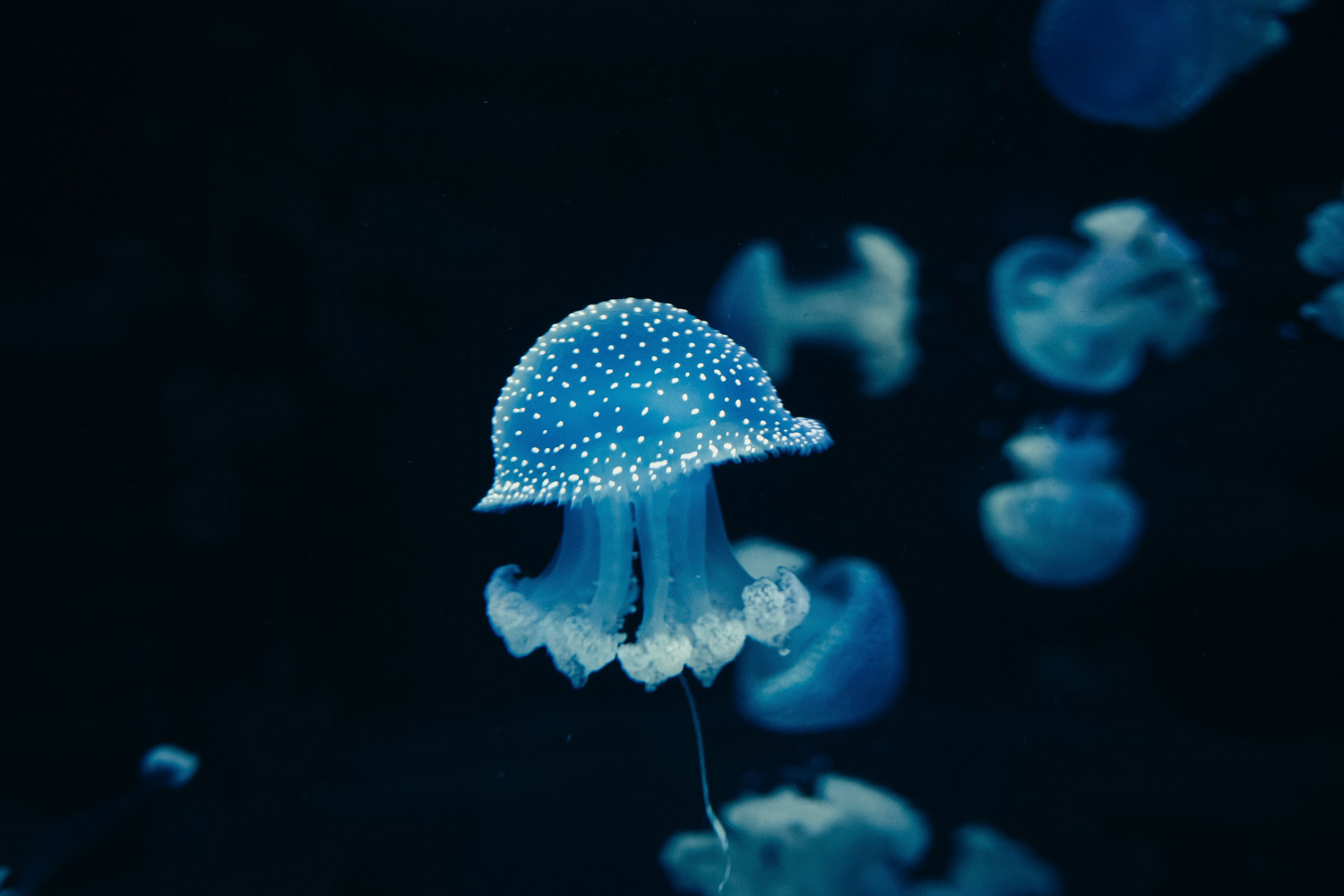
Photos credit: Timur Weber and Benni Fish on Pexels, Vitaly Gariev on Unsplash











I was so excited to read about this yesterday. It tingles my brains (both of them!) to imagine what this means for our understanding of our bodies and scientific development.
Really fascinating. And just yesterday, Trump and the Project 25 mastermind announced that NIH grants are now going to be vetted by scientists–and politicians. More studies of autism and vaccines, anyone?
“Oh joy, now we’re officially twice as nervous!!” I cackled! 😀
This is very interesting to a Science nerd like me, so of course I shall be devouring all of the details from as many sources that I can find. Thank you!
This makes so much sense. So many of our tasks can go on “autopilot” while others require an interior dialogue. One part of the brain is driving the car while the other part is making a grocery list.
Interesting. My son had bilateral integration problems, also known as midline problems, the right side of the brain works, the left side of the brain works, but they do not talk. So we had to do a ton of small things to get his brain to work together. Most of the work was forcing him to cross the midline of his body, which he wasnt doing, at all.
Think big sweeping sword fights and big art pictures, and handing him snacks from his left so he had to cross the midline with his right hand.
So, based on that work and issue, it does seem like they function alone, most people just integrate them easily.
I have a friend whose son was like that. They played a lot of baseball catch with him. He loved it and always wanted to do it so it really helped and quickly. I would love to say he then became a pro baseball player, but no. LOL Scientist.
This is fascinating! Wow!
That jellyfish thing tickles me too. I’m just picturing one blob sort of floating curiously toward the shore and the others quietly noping out as they bob in the other direction.