
When he was at Cannes earlier this year, Seth Rogen astutely said, “If your instinct is to use AI … you shouldn’t be a writer, because then you’re not writing.” Well said, sir, and it serves as a great template for any other creative endeavor. Say, any role involved in the musical arts. Yet AI-generated “artists” have been plaguing the industry, with “singers” landing on various Billboard charts, and even scoring multimillion-dollar record deals a genuine human artist would break circuits for. Last year, iHeartRadio took the positive step of outright banning all AI-generated music, podcasts, and DJs. Well, Spotify has just announced that they’re taking a stand too! Only without the banning part, womp womp. Here’s what they are doing, starting next month: all AI-generated content will be clearly labeled as an “AI persona” on profiles and playlist track listings. Furthermore, anything tagged as an “AI persona” will henceforth not be included in algorithm recommendations by the site. There’s a glitch, though, in how Spotify plans to suss out which “artists” are AI. See if you can spot it in this reporting:
It means that from September AI-generated artists such as the Velvet Sundown will carry the persona label and will be blocked from personalised recommendations by default. The aim is to differentiate these deepfake artists from real performers who might lose out on streams to artificial rivals.
Spotify said: “True artist-fan connection can only be built on a foundation of trust and authenticity. In music, that means listeners need to be able to trust that the artist behind the music is who they say they are. That’s more essential than ever in the age of generative AI.”
Last year Spotify revealed it had removed 75m spam tracks from its platform over a 12-month period as AI tools created a flood of fake music. Spotify’s legitimate catalogue stands at 100m tracks.
Spotify will allow music creators to reveal if their identities are AI-created — and will then label them as an AI persona — but it will not rely on self-disclosure alone. The company said it would use human review and AI investigative tools to determine if artists were fake. Although the new rule technically applies to AI “identities”, Spotify says AI-generated profiles are invariably a front for AI-made tracks as well.
The company said: “Listeners have been clear in telling us that they don’t like seeing an artist profile that seems human, only to find out that the persona is AI-generated.”
Last year there was debate about the origins of the Velvet Sundown — a 70s-style US rock band — before the band’s social media channels confirmed the subterfuge. A statement described the group as an AI creation that was “somewhere in between” human and machine.
The Velvet Sundown has 117,000 monthly listeners on Spotify but its page has no clear AI labelling, although the artist profile describes the four-piece as a “synthetic music project”.
In January there was further discussion about Sienna Rose, a soul singer who entered Spotify’s viral top 50 but did not appear to be real, having never played a gig or released any videos despite releasing a prolific burst of material over a 10-week period. The Spotify profile for Rose, who has more than half a million monthly listeners, does not clarify whether she is AI or not.
Did you catch that? Spotify says they’re gonna track down the AI-generated music on their site… with the use of “AI investigative tools.” [insert face palm emoji here] You guys, it really shouldn’t be this hard. I mean, yes, bravo to Spotify for doing something to separate the AI fake music from the craft of real humans. Would I prefer for the world’s largest music streaming platform to follow iHeartRadio’s example and ban AI content altogether? You betcha! And while we’re at it, I’ll repeat my refrain of nearly a year that Billboard still has yet to get in the game and ban AI-generated music from their charts, or at the very very least relegate it to a separate AI-only chart. Spotify’s approach isn’t all that surprising, though, as we’ve been seeing a lot of organizations roll out somewhat wishy washy rules regarding AI that oppose certain aspects but stop short of full-throated condemnations. What’s really killing me here is the detail of Spotify using AI to crack down on AI.
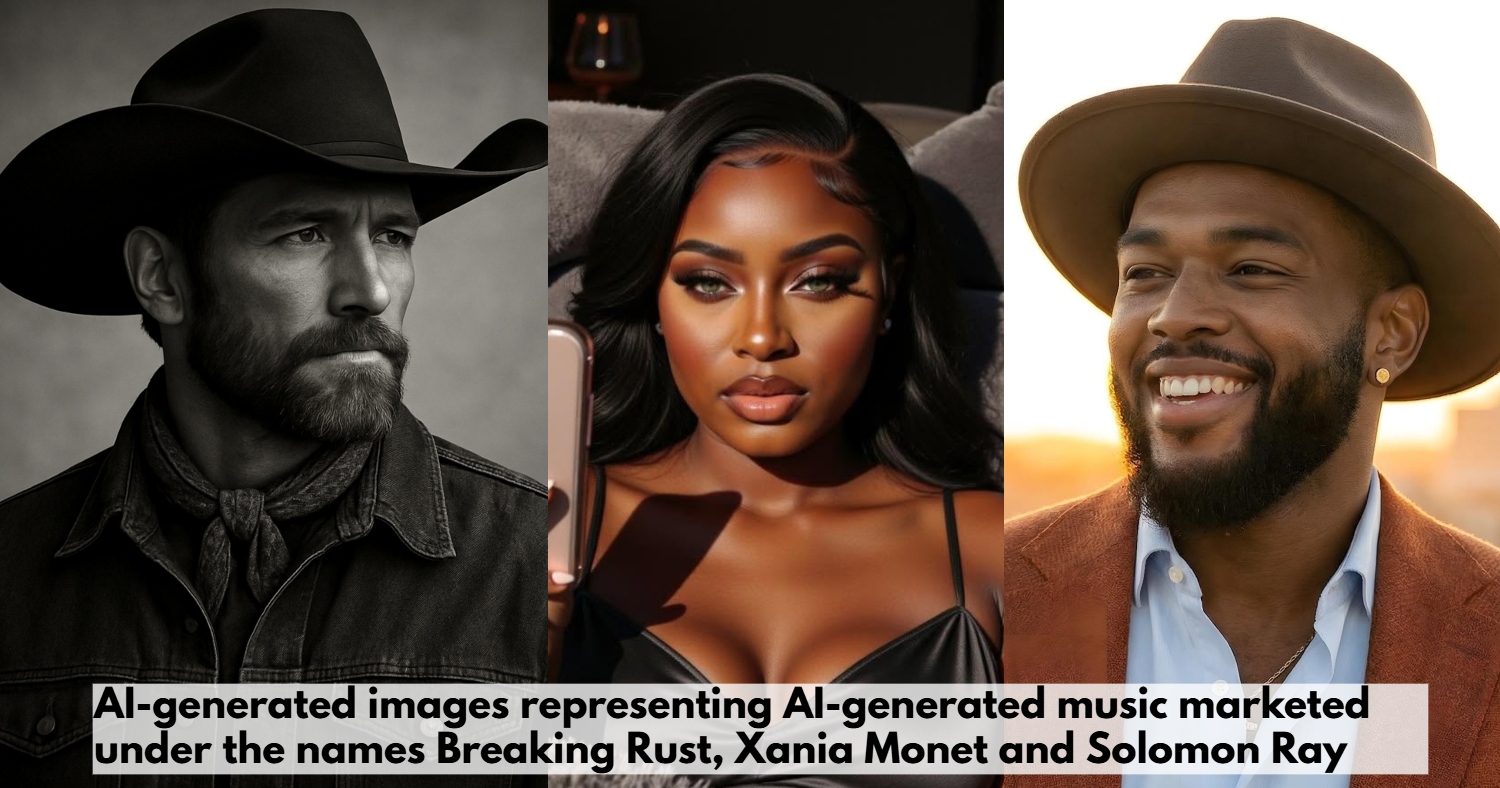
Photo note by CB: These are all AI-generated images of avatars meant to represent AI-generated music. Image on the front page is of “Xania Monet”.










Good. Now do books.
While the tech edgelord billionaires continue to push and anthropomorphize genAI we need to keep resisting – no “AI persona” “AI identity” it should be “AI avatar” “AI simulation” etc. language matters and we keep getting hoodwinked with their insipid campaigns to force genAI into all aspects of our lives.
genAI sound generations suck. They have no soul and are incredibly wasteful to produce. I feel like the massive success of “Rein Me In” Sam Fender and Olivia Dean’s passionate duet about the messiness of human emotions and relationships captures the zeitgeist in some way – leaning in to what is human and how artists express themselves through music.
I have to say I am so glad to see the very real backlash to AI. I mean I am sure like all tech it has some value but not at replacing humans and art. I saw this article that younger people are so uninterested in that and the cgi stuff and want practical and real. Which makes sense they have never had real. So much if their life and friendships are about the internet, they want tangible stuff. I know I do- I dropped all my social media (other than LinkedIn) and it’s been great.
I know the movies are a lot more fun when it’s practical vs fake, and so is music that comes from someone’s soul and is their story. Glad Spotify is doing this but really proud of the consumers for forcing them too.
I am glad they are doing this and it should be noted when books are AI too.
I’m not that opposed to this plan. I am a software engineer and use AI liberally as part of my workflow. It’s really great for some things—like doing tech drudgery. And I actually think it’ll do a very good job of spotting AI music and musicians. That seems like it would play to AIs strengths!
I heartily agree that its strengths do not include writing music. But identifying AI music would be something I expect it can do pretty well. And honestly, at the scale we are talking about, you need some kind of automation.
These profile pics are so obviously not real.