

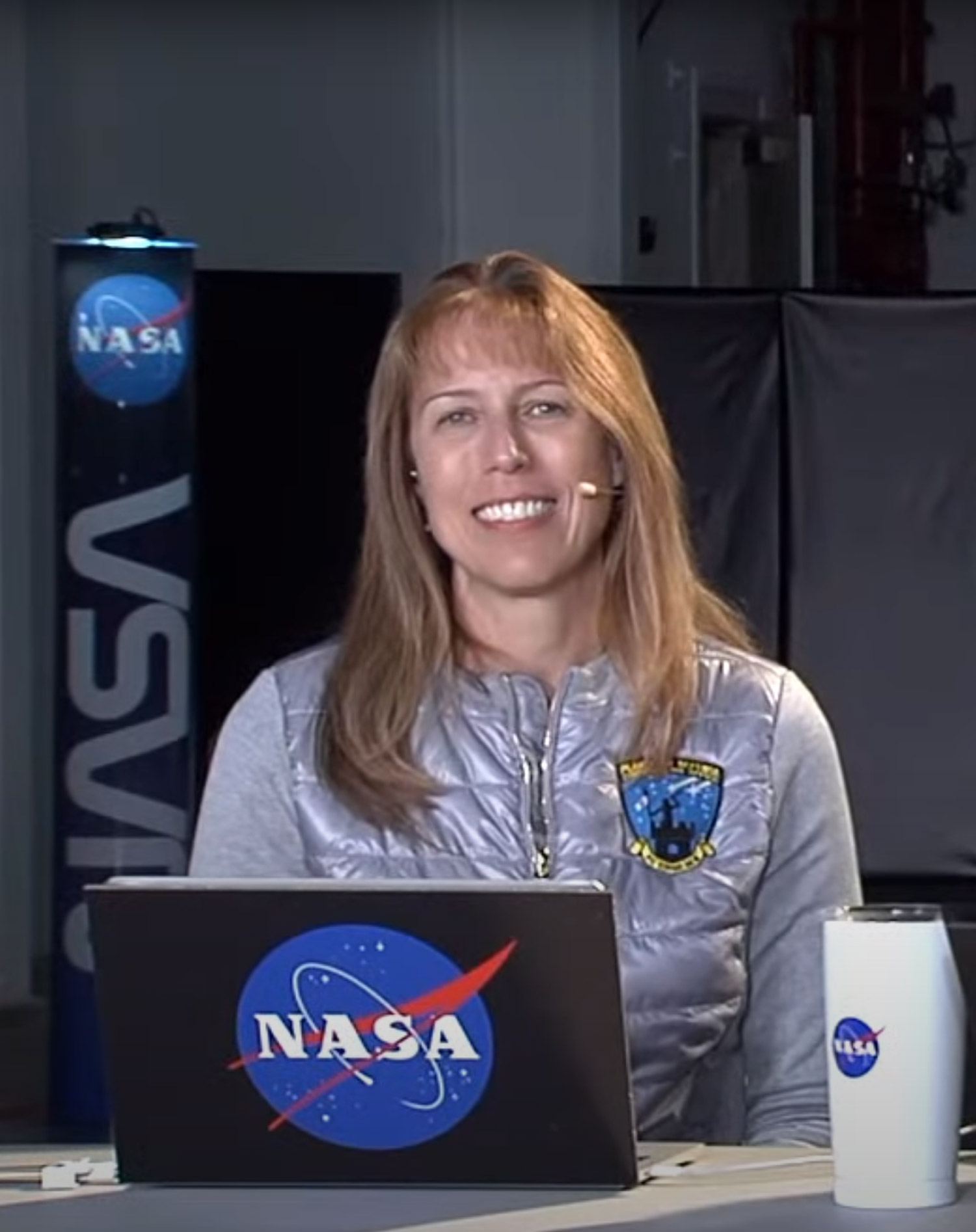
Do you feel stuck in a rut worrying over the same old manmade catastrophes day-in day-out? (Climate change, AI, the ongoing collapse of democracy and decency particularly in the US…) Do you feel up to the challenge of panicking over an out-of-this-world problem with world ending, or at least city ending implications? Well then you’re in luck, cause NASA has the humdinger for you! Last weekend, the space organization dispatched their scientist Kelly Fast — who boasts the lofty job title of “planetary defense officer” — to the annual meeting of the American Association for the Advancement of Science (AAAS) in Phoenix, Arizona. This is where Officer Fast launched into her fear of the 15-25,000 asteroids NASA calls “city killers.” The nickname is pretty self-explanatory, but it’s worth noting that these actually aren’t the biggest asteroids out there. What makes “city killers” so dangerous is that they’re small enough to avoid our detection, yet big enough to wipe out a city. Fast says it’s these goldilocks asteroids that keep her up at night, and in sharing that publicly, now it can keep us up all night too.
Fear of the unknown: She’s worried about the a-rock-alypse. A planetary defense expert is warning that humanity is defenseless against up to 15,000 undetected near-Earth asteroids that have the potential to take out a city. “What keeps me up at night is the asteroids we don’t know about,” warned Kelly Fast, a planetary defense officer at NASA, while addressing the American Association for the Advancement of Science (AAAS) in Phoenix, Arizona, the Daily Star reported. Fast clarified that she’s not worried about the “large ones” as they know “where they are,” or the small stuff that’s “hitting us all the time.” Rather, it’s the space rocks that measure around 500 feet that concern her because they’re small enough to avoid detection but large enough to make an impact.
We’ve only mapped out less than half of these asteroids: According to Fast, there are around 25,000 of these interstellar in-betweeners passing within our planet’s vicinity, and we only know the location of around 40%. She said that their inconvenient size makes them hard to detect “even with the best telescopes” as they accompany Earth in orbit around the Sun, preventing them from reflecting sunlight. To circumvent this problem, scientists are planning to deploy a “Near-Earth Object Surveyor space telescope,” launching next year. It uses thermal signatures to spot dark asteroids and comets that were previously hidden from our planet. Fast said it was her responsibility to “find asteroids before they find us” and potentially develop methods of “getting asteroids before they get us.”
Solved with a game of Dart? Unfortunately, even if scientists did manage to detect these incognito space stones, there might be little we could do to stop them. In a groundbreaking 2022 experiment, NASA purposefully crashed a spacecraft called Dart (Double Asteroid Redirection Test) into the mini moon Dimorphos at 14,000mph, proving that asteroids could be knocked off course.
We’re gonna need a bigger fund: “We would not have any way to go and actively deflect one right now,” rued [Dart mission leader Nancy] Chabot, a planetary scientist at Johns Hopkins University. However, she doesn’t foresee space agencies investing in such a measure as they “lack the funding to keep planetary defenses on standby.” “We could be prepared for this threat,” she warned. “We could be in very good shape. We need to take those steps to do it.”
“What keeps me up at night is the asteroids we don’t know about,” has the misfortune of sounding like Donald Rumsfeld’s infamous “we don’t know what we don’t know” malarkey. But what’s frightening is that in this case, we DO know what we don’t know, we just don’t know where or when. And we have an administration that doesn’t believe in funding science. Greeeaaaat. If at this point you’re thinking, “Easy peasy, we’ll just have the Avengers take care of it,” then, well, you’re actually not that far off from NASA’s own planning. They’ve been tracking one of these city killers, asteroid YR4, since 2024 when they thought it was headed towards Earth. Now YR4 is projected to maybe possibly crash into the moon in 2032, and scientists are considering a “nuclear robust disruption mission” to keep that from happening. In other words, they’re entertaining the idea of pulling an Armageddon. What a world.
PS — I did not have the NY Post pegged for bad dad jokes, but then they went and detonated the “a-rock-alypse.”






-

- London, UNITED KINGDOM – Duke of York, Prince Andrew continues to get probed about his involvement with the Jeffery Epstein case. Pictured: Prince Andrew At The Commonwealth Institute when he visited a photographic exhibition in London England. **SHOT ON May 4th, 1984** BACKGRID USA 18 DECEMBER 2020 USA: +1 310 798 9111 / usasales@backgrid.com UK: +44 208 344 2007 / uksales@backgrid.com *UK Clients – Pictures Containing Children Please Pixelate Face Prior To Publication*

Real scientist photo credit: Evmuser via Wikipedia, Public Domain, other photos credit: Niko Tavernise/Netflix via Netflix press











I wonder at what point they -would- be able to detect them, once they enter our atmosphere down to a certain level? Luckily (?) I think most of them would hit the ocean, but once that happens it’s tsunami territory. Yay! Knowledge is a curse hahaha
Until not too long ago, this story would have been prime fodder for my 3AM catastrophic-thinking jamborees. Now it barely even registers against the other horrors that we’re facing.