
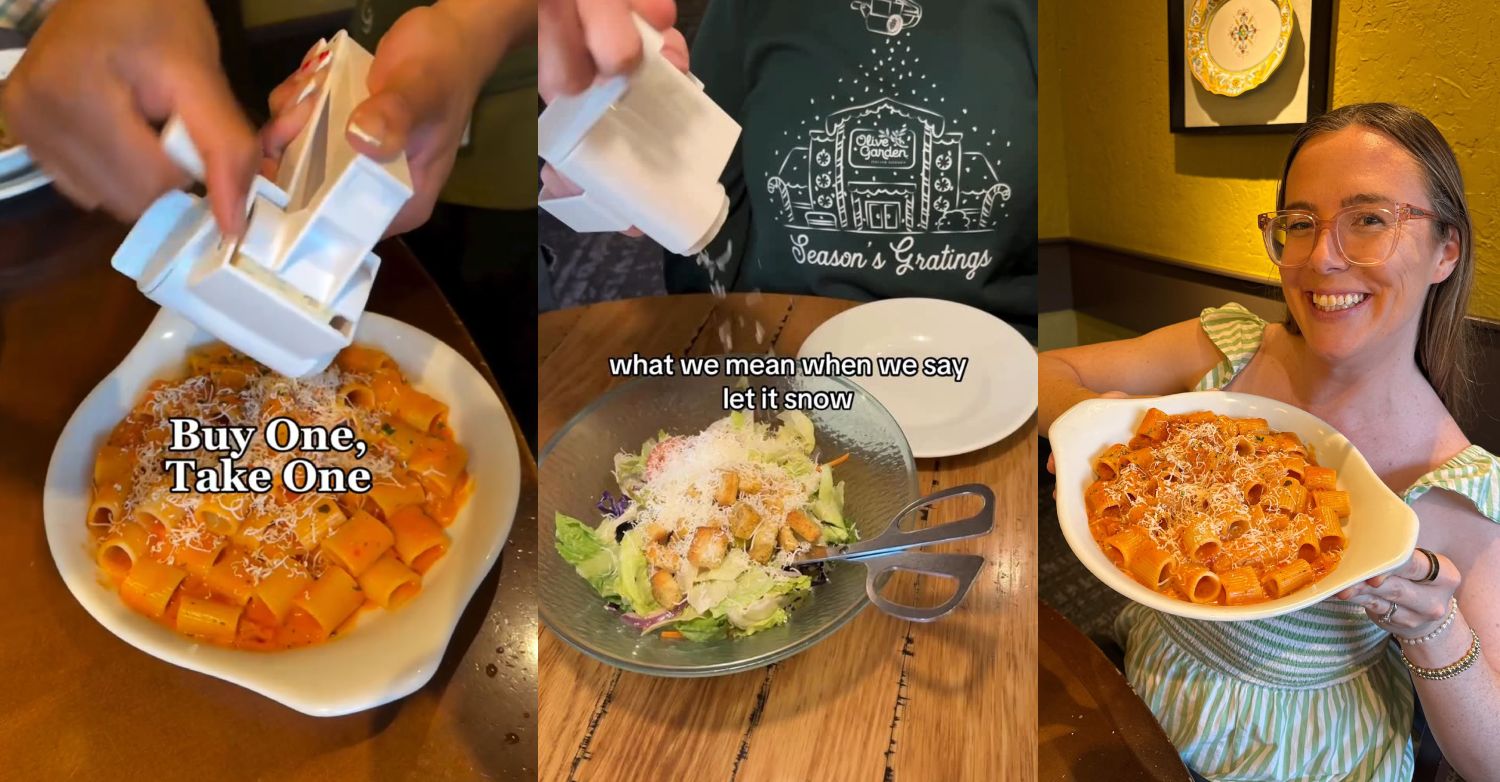
It’s been a minute since I’ve been to an Olive Garden, so forgive me for not knowing they had an “unlimited cheese” policy, wherein servers will grate above your dish until you stop them. Is this expressly written down on the menu? Does it specify precisely what kind of cheese is falling delicately onto your soup, salad, or entree in quantities to your heart’s content? I ask because whistleblowers have bravely come forth to reveal that their former employer Olive Garden actually uses Romano cheese instead of Parmesan in order to cut costs, implying that the general assumption all along has been that OG serves authentic Italian Parmigiano Reggiano. So we really need to clear up what OG promised — in writing — in order to temper the appropriate level of outrage! As a lover of cheese and food writ large, I’ll start out high at righteous indignation!!
Thanks to Internet sleuths and former Olive Garden employees, the trade secret about the cheese they really use has finally been revealed.
Food YouTuber Ordained Cue spilled the secret to followers that Olive Garden’s alleged Parmesan cheese is actually Romano cheese.
“Olive Garden has been lying to you and you didn’t even know it—and it’s about their bottomless parm that they serve,” he says in the clip. “They’ve been fooling us all along when they come around to your table and offer you freshly grated parm for your pasta.”
Specifically, he explains that Olive Garden is still using a real Italian cheese, a Romano cheese from an Italian cheese company called Lotito. The reason: real parmesan is simply too pricey due to standards on ingredients and production.
Parmigiano Reggiano is regulated in Italy under the Consorzio del Formaggio Parmigiano Reggiano, and must meet a number of criteria to be deemed legitimate.
The Consorzio defines Parmigiano Reggiano as a “hard cheese, obtained from cooked and slowly matured paste, made from raw cow’s milk, partially skimmed, produced by cows whose feed consists mainly of forage from the area of origin.”
Romano cheese is described by Stella Cheese as “similar to Parmesan, but with a sharper, saltier bite that adds a pleasantly tangy flavor to a wide variety of dishes.”
But back to Parmigiano Reggiano. True Parmigiano Reggiano is classified by where it is produced: “the milk and the cheese are produced in Italy in the defined geographical area which comprises the provinces of Parma, Reggio Emilia, Modena, Mantua (on the right bank of the Po river) and Bologna (on the left bank of the Reno river), in compliance with strict standards.”
There are also four guidelines for ingredients: “Dairy cows fed mainly with forage from the area of productions (Silage is forbidden); Milk, cheese making process, and minimum aging (12 months) in the area of origin; Always only 3 ingredients: milk, salt and calf rennet; and 100% of the wheels checked by the Consorzio.”
Mama mia, not the Consorzio again! We were just talking last month about another Consorzio — Consorzio di Tutela del Pomodoro San Marzano dell’Agro Sarnese-Nocerino — when reviewing the California class action suit alleging TOMATO FRAUD against Cento Fine Foods. But Olive Garden’s crime isn’t fraud, so much as the sin of ommission. They let us think it was buon-ified Parmigiano Reggiano this whole time! And for what? Romano (especially Pecorino, YUM) is no slouch of a cheese! It’s not like they were grating out arugula instead (iykyk). Obviously Olive Garden will have to answer these questions under deposition for the eventual court case, but they’d do well PR-wise to reach out in good faith now to customers hungry for answers. Otherwise we’ll just be marinating in resentment. I’m taking away two important lessons from this scandal: 1) cheese obfuscation is not a victimless crime, and 2) do not mess with the Consorzios, they will always grate you down to size.










I’ve only ever eaten at the OG twice (which is enough), but it seems to me what they really don’t use is any salt in the pasta water. So bland!
It came out a few years ago that Olive Garden doesn’t salt their pasta water. Which explains why their pasta is so bland.
Boy oh boy! I can’t wait for this cheesy scandal to ferment.
I haven’t eaten there since before the pandemic, but it was overpriced before the price spikes that I am sure have happened in the last 5 years. The quality has always been mediocre. Consumers really need to start pushing back at being charged exorbitant prices for mediocre and inferior products. More corporations need called out on this type of nonsense and consumers need to use their buying power to punish corporations who play these stupid games.
If the Olive garden had an “endless parm” promotion I would never have assumed that they used Parmigiano-Reggiano. I would have assumed it was a lesser expensive Parmesan cheese. I don’t see the sense in getting your knickers in a twist over them using the lesser expensive Parmesan. However, if they promised Parmesan and used solely Romano that is different. Maybe they put a bit of Parmesan in with the Romano?
But it is still no big deal and I have always preferred Pecorino Romano over Parmesan and Parmigiano-Reggiano. But even then, I would assume that the Olive Garden is using a less expensive version of Romano.
Exactly, Romano (agree, Kismet, pecorino all the way) is a better cheese and I will die on that hill. My Italian (first generation) grandma used it on her table instead of Parmigiano, so does my mom/her daughter, and so do I. Parmigiano Reggiano has its place and I always have some in the house, but pecorino Romano is more flavorful, more versatile, melts better, and is a better all-around Italian cheese IMO.
Nothingburger.
The people who actually care about the authenticity of cheese would never set foot into an Olive Garden in the first place.
This is just about emphasizing the origin-based copyright of a food name. We lazily refer to all these grated cheeses as “Parmesan” even though that name should only refer to cheese from Parma. (Same with folks calling all sparking wine “Champagne”.)
I appreciate this organization wanting to protect the integrity of the name. But there’s no controversy unless OG is intentionally misleading their customers. (And I don’t mean ignorant OG waiters casually offering diners ‘more parm?’)
Yeah, everything you said. Plus, does this consortium have a reach that extends all the way to American restaurant chains? If Olive Garden is serving something they call Parmesan & it doesn’t actually come from that part of Italy, are they going to get sued? Do they have that kind of reach & power?
Whatever they use in their entrees makes me very sick. I can only eat the soup, salad and breadsticks there.