
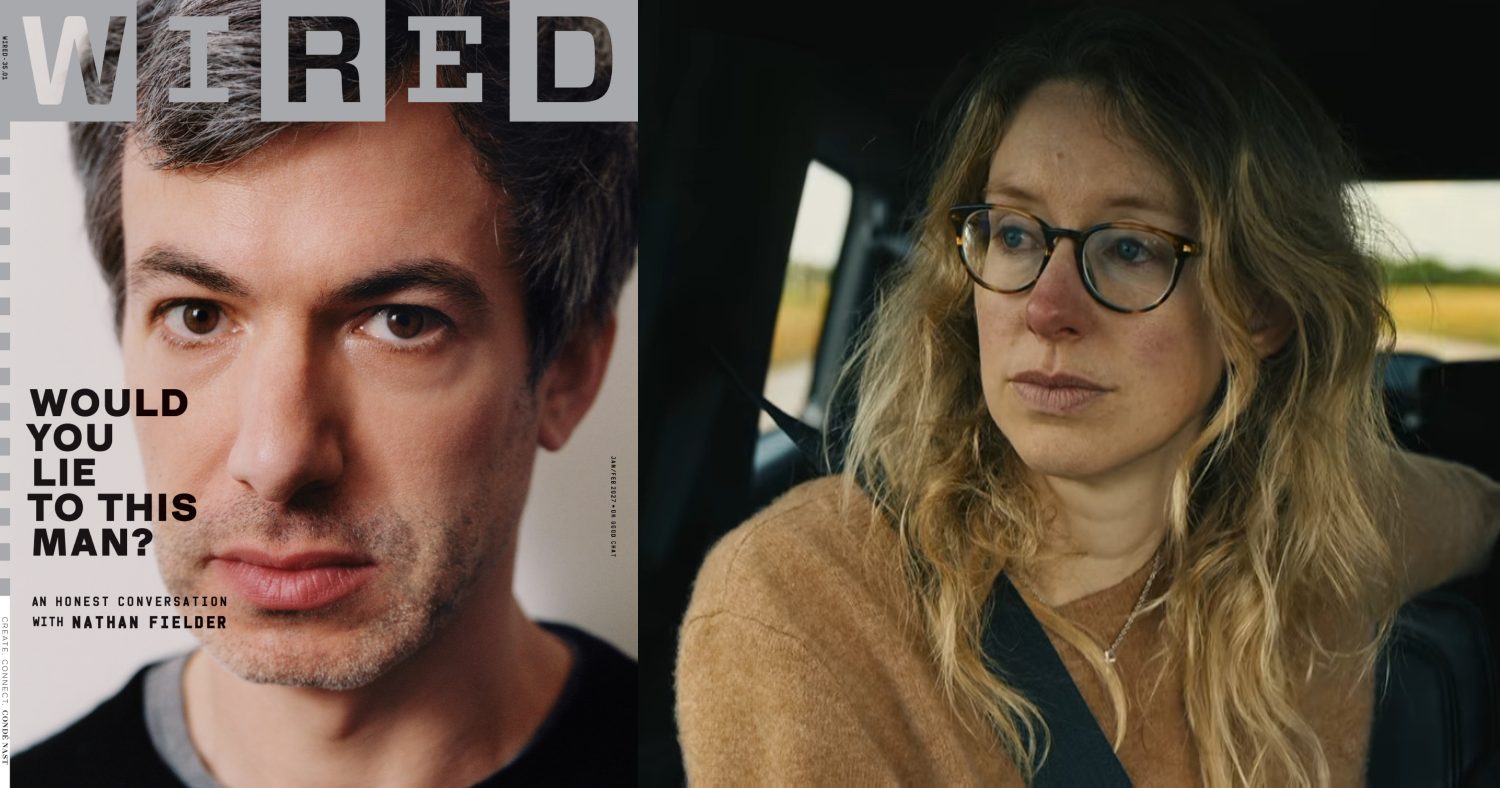
I saw the new Elizabeth Holmes documentary, You Can See Everything, over the weekend, and while my usual inclination would be to say everything about what I saw, Nathan Fielder and codirector Lance Oppenheim really crafted the film in such a way that you want to preserve the experience for future audiences. I already fear I’ve said too much! So I’m really trying to stick to neutral ground in my coverage, things more like process than content. At least my job is easier than Fielder’s, who has to promote the film himself, now, despite not really wanting to talk about it at all, in the name of keeping new viewers’ impressions as untainted as possible. Katie Drummond at Wired very candidly relays the challenges that presented to her as a journalist interviewing him for this month’s cover, though she lands on the process being positive overall. (Plus she got to see the doc before even the Telluride screening, and a few times at that, so there.) Here forthwith are some spoiler-free highlights:
Daily processing sessions among the sparse crew: One of the reasons early on that we felt this could actually be a project was because of what came out of those processing sessions. At the end of the day, I would have in my head what I thought was a very clear idea of what was happening, and Lance or our camera guy, Jonathan Mitchell, or our DP, David Bolen, or our sound guy, Richard Carlos, they would all have a different take on what actually happened. I was like, how is this possible? We’re all in this room experiencing this thing. We’re all witnessing something and having a different idea of what’s going on. And I thought that was a basic premise to explore and chase.
How Fielder came to be on camera, which was not the original plan: Firstly, because I was there, they would keep engaging with me. So they would be talking to each other, but then they would be like, “Nathan, what do you think?” And I would chime in from off camera. Or if nothing was really happening, I would ask a question to see what they would say about something. But I was off camera, and it was more to prompt a discussion or something like that. Or they would start talking to me, and conversations would go on for long enough that the operators started panning over to me. But also, they would say stuff that tickled a part of my brain that was like, “Something’s off about this.” Or I feel like this is them trying to do some sort of propaganda. So I would wanna interject to be like, “Well, actually, I read this,” or “I thought this was the case.” We realized, “Oh, someone has to push back, and we can’t just let them run whatever show they kinda wanna do.”
Holmes called Fielder for the first time in over 6 months a week before the film came out: So I answered the phone, and I said, “Hey, how’s it going?” She asked how I was doing. I asked her if she had seen any stuff about the film coming out and how she felt about it all. She told me that she had seen some stuff, but most things she just isn’t seeing, so she’s heard things, but she hasn’t really read anything. And then, at the end, she said to me—“I trust you.” I said, “OK, thanks.” … She talked about her kids, and then some updates that are not really my place to share. But then after that, she said again, at the end of the call—“I trust you.” And I don’t know what she meant by that. She said it twice.
The full interview is a fascinating read. (And on the whole I don’t think Wired included any spoilers, I’m just erring on the side of caution.) The comment Fielder makes about all of them on the crew having wildly different takes (film pun!) on what just happened that day really captures the essence of You Can See Everything, and why early reviews describing it as a cinematic Rorschach test were apt. We get to see everything, and everyone sees something different. It’s also nice to hear Fielder say so clearly that he ultimately stepped on camera to challenge Holmes and Evans when he felt they were feeding him bull. He performs this task well, and so so kindly and gently. Arguably definitely with more kindness than the subjects deserve. And likely why Holmes ended up calling Fielder from prison to say “I trust you,” twice. To be clear: I took this as a credit to Fielder’s character and the way he conducts himself, and not Fielder endorsing or deferring to Holmes. Of course, that’s just how I saw the inkblot.









I’ve watched the trailer a few times and read various reviews about it and one thing that strikes me is that it seems to clearly show the very odd dynamic between her and Evans. I read a comment that its not really clear who the manipulator / manipulatee is, as Evans seems to be just as much of a manipulative narcissist as she is.
Its interesting that Evans negotiated a share of the films profits and then gave them up before its release – by many accounts its going to do well at the box office and likely award season.