
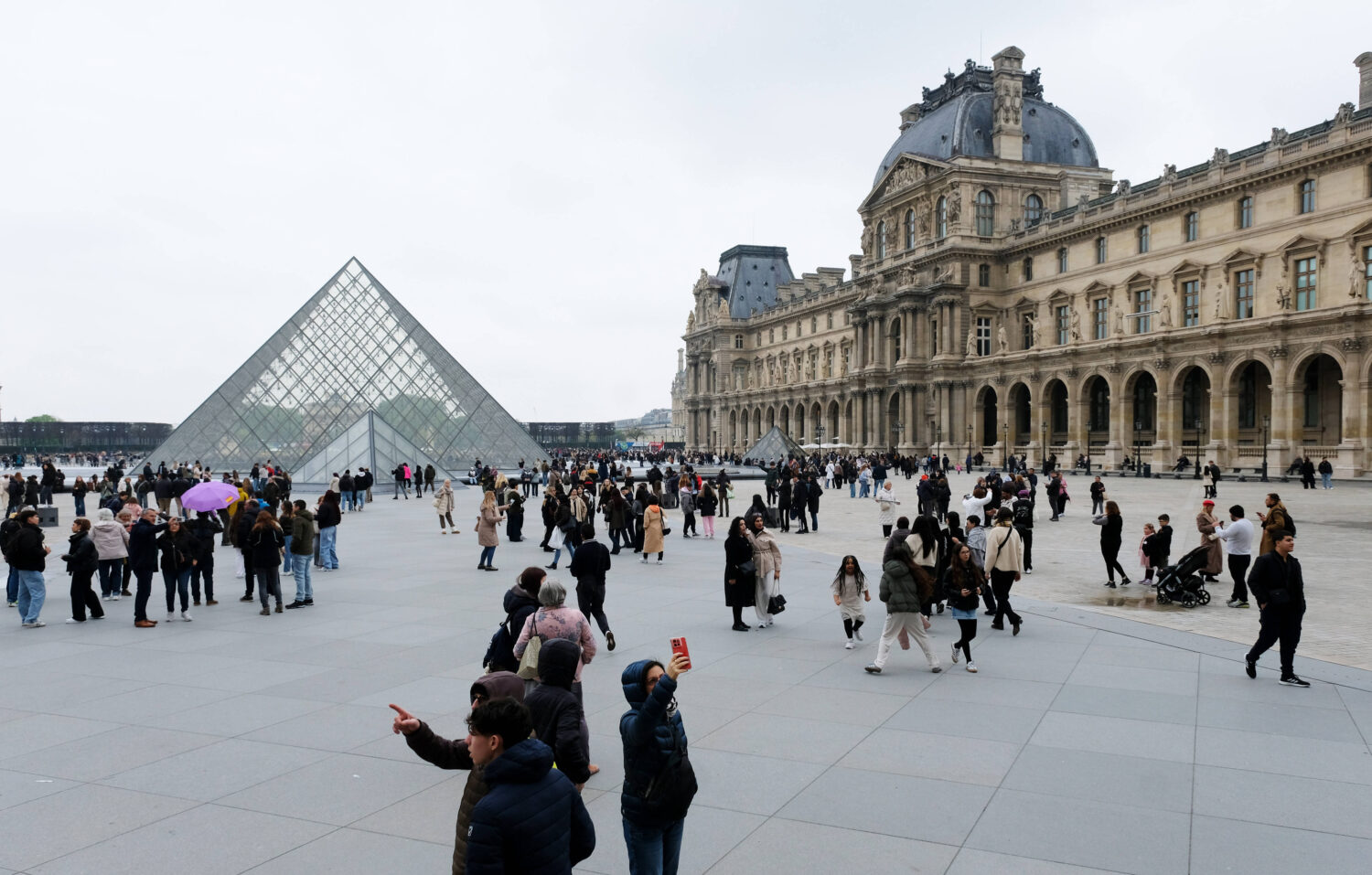
We passed a grim anniversary on Monday: one year since $100 million worth of French crown jewels were stolen (in broad daylight and seven minutes) from the Louvre. I’m no expert on art theft and recovery, but I don’t think we’re ever going to see those gems again. Only one piece of the suite remains after the thieves dropped it during the getaway: the 19th century Empress Eugenie crown, now missing one of its eight golden eagles and 10 of its 1,354 diamonds, though all 56 emeralds are miraculously intact. Curators are still pondering how best to display this survivor. Moving beyond the Louvre, it turns out that initial brazen job — where criminals cracked the Louvre’s security code of “Louvre” — sparked a wave of smash-and-grab heists, hitting 15 museums since 2025. On the occasion of this ignominious milestone, The Wall Street Journal has an article identifying the various trends and sites across the recent spate of thefts. It truly is pearl-clutching reading:
Gems and gold over paintings: In 10 of the subsequent museum break-ins across Europe over the past year, thieves bypassed paintings to steal objects that could be dismantled or melted down because such commodities retain value as precious metals and gems. Black-market jewelers from Antwerp to Tel Aviv are often willing to re-cut and reshape bigger jewels into smaller untraceable ones that can be resold anywhere, investigators say. On Oct. 5, thieves broke into the C. Karoutzos Contemporary Art Center in central France and hauled off a 330-pound bronze book cover decorated with gold, gems and shells designed by surrealist Salvador Dalí. Museum owner Christian Karoutzos said his video cameras captured a few shadowy figures leaving the scene, but the book cover remains missing. “This is a true tragedy,” he said.
Speedy stealing: In 1990, two men disguised as police officers spent 81 minutes crisscrossing Boston’s Isabella Stewart Gardner Museum to cut out and carry off masterpieces by Vermeer and Rembrandt. This year’s heist at the Magnani Rocca took less than three minutes. Geoff Kelly, a former FBI agent who investigated the Gardner heist and now works with other former art-crime agents at the museum-security firm, Argus, said thieves are breaking in, grabbing what they can and fleeing the scene within minutes—before the police arrive. Even if museums or individual artworks are alarmed, the real chase tends to begin only after the thieves have fled, Kelly said.
Sad museum exhibits: Victimized museums are often compelled to cope by closing indefinitely or reopening with fewer treasures on view. The Louvre has reopened its Apollo Gallery, but all the remaining jewelry in it has been removed, resulting in an empty, 17th-century ceremonial gallery. In Spain, Villena’s Municipal Archaeological Museum has been shuttered since Aug. 27 when thieves pried open a side window, broke into a bulletproof case and made off with dozens of Bronze-Age gold objects silver and amber objects, including bracelets, bowls, bottles and three crowns. In about three minutes, the museum lost its main attraction.
More sad museum exhibits: Véronique Brumm Schaich, director of the Lalique Museum in France, said she and her staff were initially in shock after thieves in July smashed six display cases with sledgehammers and stole 27 works, mostly jewelry—including pieces designed by René Lalique. After upgrading its security, Brumm Schaich said the museum is readying to reopen Nov. 28, but with one noticeable change: Its gallery devoted to Lalique’s early jewelry designs will not showcase any objects but will be filled instead with photographs of his works. “Reopening without jewelry inevitably means telling that story differently,” she said, “but we felt it was better to reopen in this way rather than prolong the museum’s closure.”
Let me get this droite: patrons of the Lalique Museum can now pay to view photos of Lalique jewelry, instead of getting to see the jewelry itself? (We could do this for free online, non?) And all in the nom of protecting the pieces from thieves. This is why we can’t have nice things!! Merde. And quelle surprise, elsewhere the article went into how cyberattacks (like the one that recently hit French supermarkets) and AI are the smash-and-grab heist’s best friends. For obvious reasons: cyberattacks can make security systems go down, while AI is being used by thieves to source what loot to steal from which museums. I repeat: this is why we can’t have nice things!!
But to try and eke a positive angle out of this, guess it’s a good time (comparatively speaking) to be a painting? The genuinely good news on that front is that many of the recent painting thefts have led to full recoveries, including for the three works stolen from the Magnani Rocca Foundation in Italy last March, and the four pieces stolen from the Renoir Museum in Cagnes-sur-Mer last month. None of this reporting, however, does anything to explain the impetus behind perhaps the most egregious heist of the year: those 12 tons of KitKats — that are still at large! Oh gods of art and treasure, give us a break!











Commenting Guidelines
Read the article before commenting.
We aim to be a friendly, welcoming site where people can discuss entertainment stories and current events in a lighthearted, safe environment without fear of harassment, excessive negativity, or bullying. Different opinions, backgrounds, ages, and nationalities are welcome here - hatred and bigotry are not. If you make racist or bigoted remarks, comment under multiple names, or wish death on anyone you will be banned. There are no second chances if you violate one of these basic rules.
By commenting you agree to our comment policy and our privacy policy
Do not engage with trolls, contrarians or rude people. Comment "troll" and we will see it.
Please e-mail the moderators at cbcomments at gmail.com to delete a comment if it's offensive or spam. If your comment disappears, it may have been eaten by the spam filter. Please email us to get it retrieved.
You can sign up to get an image next to your name at Gravatar.com Thank you!
Leave a comment after you have read the article