
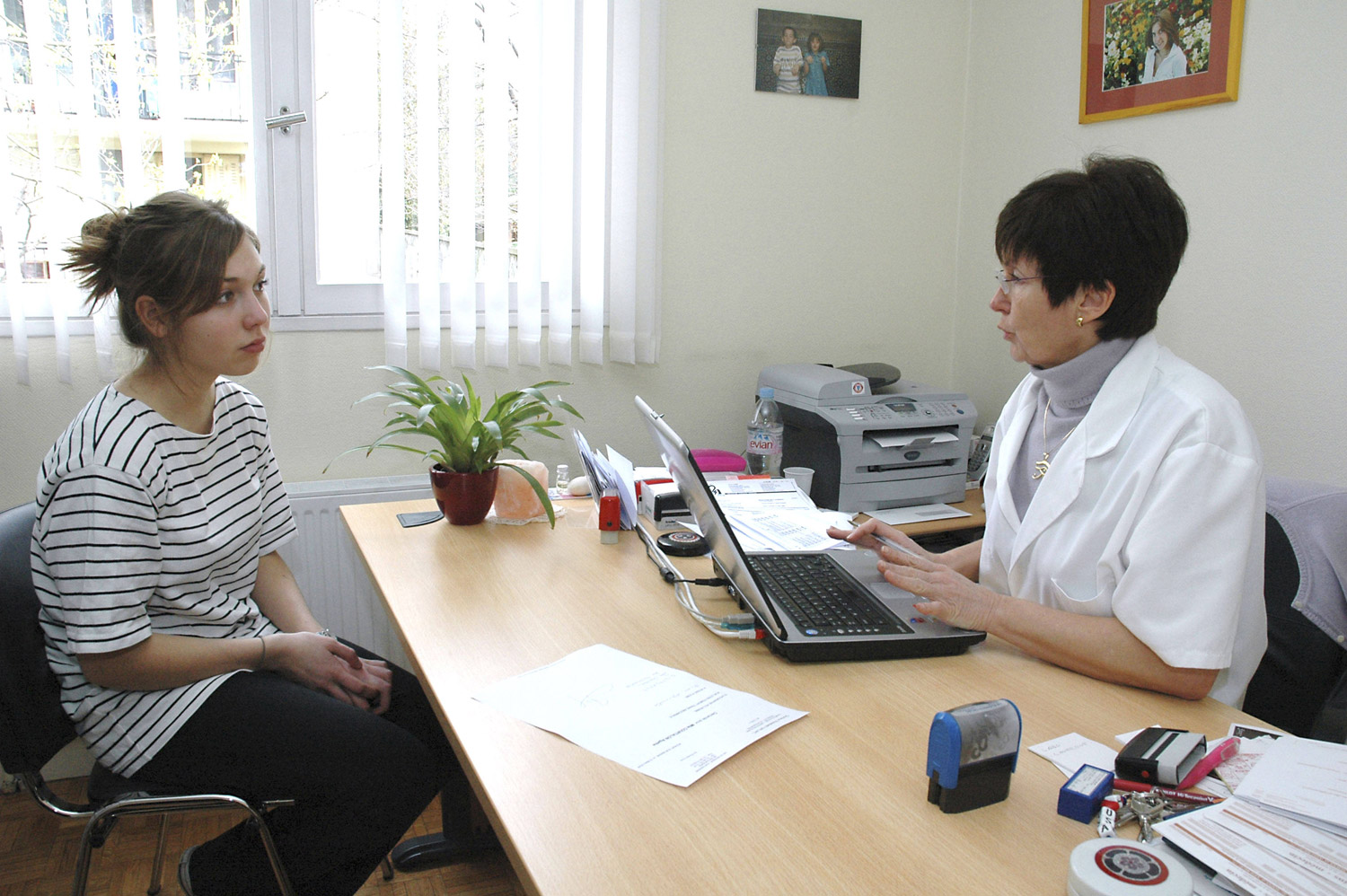
Two medical issues have been consistent in my life: 1) Aside from a brief successful stint on Weight Watchers in my early 20s, I’ve always been overweight. 2) My visits to the gynecologist are, without fail, utter sh-t shows. My very first appointment as a teenager basically set the tone; I was very obviously in pain from the speculum and overwhelmed with everything, when the doctor said, “Your first time having sex is gonna be excruciating unless you have surgery.” On the one hand, a problem with a solution (surgery). But still, it was a lot for a nervous, sensitive girl to hear, and I marched into adulthood carrying that moment with me.
I freely admit that I’ve responded to my lousy gyno exam history in the worst way — waiting too long between appointments. That approach made it hard to get answers about changes I’ve been observing. Like when all of a sudden a few years ago, my periods became irregular (whereas before I could tell time by them). Also in this same time frame, my weight has gotten worse than usual, which I thought was due to emotional eating in the wake of my father passing (three years ago in August). Until last summer when I dutifully showed up for a gyno visit with a new doctor (first and last visit: she forgot to do a breast exam, then totally gaslit me when I called her out on it), who diagnosed me with polycystic ovary syndrome, or PCOS. The PCOS explained the irregular periods, big weight gain, and other delightful symptoms that have popped up in the later half of my thirties.
Like many areas of women’s health, PCOS is under-diagnosed and researched. Even the name isn’t accurate, as cysts are not a part of the syndrome! So after a 10-year effort involving multiple surveys and input from tens of thousands of people, PCOS is finally being renamed: polyendocrine metabolic ovarian syndrome, or PMOS.
Time to desist with the ‘cyst’: As a name, PCOS had several limitations, including providing an inaccurate description of the condition, which does not manifest through cysts on the ovaries. This led patients to attribute ovarian cysts to PCOS and risk being underdiagnosed for other conditions, said Rachel Morman, chair of trustees at Verity, a U.K.-based charity and advocacy group for PCOS patients. Because doctors, too, would focus on the cystic presentation of the condition, patients could be dismissed if they didn’t present with cysts, even as they suffered from the metabolic and fertility issues linked with PCOS.
Name goals: Overall, about 22,000 people across the globe — doctors, researchers, patients, charities — shared their thoughts on a new name. Asked what they wanted a new name to accomplish, the primary response was avoiding stigma, followed by ease of communication and scientific accuracy; they preferred an accurate, descriptive name versus a generic one, and indicated a strong interest in including the involvement of the endocrine system in the condition.
A landslide! The winning candidate, PMOS, was chosen in a landslide earlier this year over two other candidates: endocrine metabolic ovulatory syndrome and ovulatory metabolic endocrine syndrome. Out of 90 voters (including doctors, researchers, patients, advocates), 87 supported it immediately, and another came around by the time the manuscript was submitted.
Dissenters were worried about men & marketing: Their concerns were primarily that the name changed too much without changing enough: It didn’t allow for the potential male expression of the condition, which is being studied and was one of the factors leading to the renaming push, while it changed the acronym, requiring a significant marketing effort to disseminate the new name.
Including men would have been a greater mistake than keeping the old name: “I fundamentally do not agree that waiting for a name change and then potentially changing it to encapsulate men is a wise thing to do. In fact, I would think that that would be even more harmful than keeping the name PCOS,” [Morman] said, adding that expanding the condition’s name to men would have diluted the resources dedicated to women, who are already shortchanged when it comes to medical research efforts and funding.
If you have the time, the full article is a highly fascinating and entertaining read. Both in terms of the science, and also the snapshot of decision making in Academia. Those big minds have BIG personalities! I mean, are you kidding me with the “But we should wait to include the men!” nonsense?? I understand the science may eventually show they belong in the conversation; but golly, I couldn’t stop thinking, “Hey men: this ONE thing isn’t about you!” And one of the two dissenters had a lengthy quote about all the rebranding she’s gonna have to do because of the name change. “I have to buy new trademarks! I have to retitle my book!” While true, those aren’t winning arguments for keeping a medical condition inaccurately named. But it was this line about the dissenters that really did me in: “Their concerns were primarily that the name changed too much without changing enough.” Tell me you’ll never be pleased without telling me you’ll never be pleased.

Photos credit: IMAGO/TIROT/BSIP/Avalon, Kaboom Pics on Pexels and iam_os on Unsplash











The name changed too much without changing enough. If ever a sentence encapsulated life as a woman there it is.
Do X. No, not like that. Do Y, no, not like that. Sigh.
Sorry to hear about your health issues and the loss of your father Kismet and thank you for covering this. It feels like such a surge forwards when something that affects women really is taken seriously.
Glad this is getting recognized as an endocrine and metabolic disorder. Hopefully most doctors will stop ignoring it and stop telling us to “just lose some weight”.
Maybe I’m dense, but I really don’t get what this disease has to do with MEN. Men do not have ovaries, right?
In any event, thanks for educating us on the name change, Kismet. I used to work with a woman who was laid low every month for several days due to extreme pain because of this.
Thank you Kismet, for bringing this to our attention. It was a fascinating read, and I have learnt a lot in one sitting. A great way to start the day.
I’m pleased to see that they prioritised the effects on long-suffering women when deciding on the new name, instead of waiting to centre men in the equation. Commonsense ruled the day, and in a landslide to boot. About time!
I was in my 20’s when I went to the hospital for some routine tests and thinking that I was already there, I went to see a gynaecologist for a check up. At that time, I was having very heavy bleeds during my periods and the time between cycles were getting shorter but I didn’t think of any of it. The doctor did the usual pelvic exam and referred me for an ultrasound, it turns out that I had a fibroid/myoma growing past my uterine wall and that my uterus was swollen because of it along with the heavy bleeding and frequent periods. I had to have surgery because of it. If something is unusual I recommend having it check.
PCOS is so broad that renaming it describes it better for women.
I had no idea cysts weren’t part of something described as cystic. It is insane that women’s health is so understudied and that women weren’t even included in medical studies until 1993. Perimenopause also feels like a brand new word and it is almost incomprehensible to me that my mother’s generation, even my older sister’s generation, had to suffer through all of those unpleasant symptoms and I don’t.
Thanks for sharing the new name of the condition formerly known as PCOS, Kismet.
While I do get that men might also be affected by endocrine metabolic syndromes, they don’t ovulate.
So, as this is about women’s biological issues and health, the name change still indicates it’s about the hormones that affect the reproductive cycle.
That said, medical misogyny is real, sadly, as is medical gaslighting — and I hope you’re doing better now, Kismet, and that you’ve found a better, nicer, more capable gyno.
Well, great news, a more accurate name! Hopefully, this helps more women figure out what is going on with their bodies and get the support they need. My 19-year-old daughter was diagnosed with PMOS this year by our PCP, but only because we had suspected it and she shared a list of her many symptoms, and PCP agreed. She is on Spironolactone and Trizepitide, which seem to be helping improve things for her.
I just texted her about the rename, and she replied with Piss Me Off Syndrome.